
Active Warrants in Richland County
Warrants in Richland County come from the courts. Under the South Carolina Judicial Branch, magistrates are responsible for issuing arrest and search warrants, setting bail, and holding preliminary hearings. Judges issue bench warrants, often when a person fails to appear or violates a court order. General Sessions records held by the Clerk include warrants filed for felony and serious criminal cases.
There is no public, real-time county warrant list to browse. No official active-warrant search portal was found on the Richland County Sheriff or county court pages. That means a careful check uses the public case index for warrant entries, plus a call to the issuing court or the Sheriff's Department to confirm. Warrant status can change quickly once a person is arrested or a court recalls the warrant.
The split between courts matters. A magistrate handles the bulk of arrest and search warrants for summary-level matters and sets bail. For felony and serious cases, the warrant is filed with the Clerk as part of the General Sessions record, alongside indictments, sentence sheets, and bond papers. A bench warrant is its own thing: a judge issues it inside a pending case, most often after a missed court date. Tracing the warrant back to its court is the key to resolving it.
Types of Warrants in Richland County
Warrants come in several forms, and the type tells you which office to contact. Arrest and search warrants usually come from a magistrate. Bench warrants come from a judge in a pending case. Family Court can issue enforcement warrants in contempt or support matters.
- Arrest warrant - authorizes an arrest based on probable cause, usually issued by a magistrate.
- Bench warrant - issued by a judge, often for a missed court date or a violation of a court order.
- Search warrant - authorizes a search of a named place, person, or property.
- Capias / failure-to-appear - a hold or arrest order tied to a missed appearance or unmet condition.
- Family or civil enforcement warrant - arises from contempt, child support, or court-order violations.
- Fugitive warrant or hold - tied to an out-of-jurisdiction arrest or extradition.
The type also tells you the likely bond path. An arrest warrant usually leads to Bond Court after booking. A bench warrant for a missed date may be cleared by contacting the court that set it. A search warrant does not name a person for arrest at all; it authorizes a search. Match the warrant to its court before you decide what to do next.
How to Search Richland County Warrants
Since there is no dedicated county warrant portal, start with the Richland County Public Index. Warrant and bench-warrant entries can appear as actions inside an individual case docket. If you find a related case, call the court that issued the warrant. For verification, contact the Sheriff's Department or appear with counsel.
- Search the Public Index by name or case number for related Richland County cases.
- Open any matching case and read the docket for warrant or bench-warrant entries.
- Call the issuing court: Magistrate or Bond Court for summary matters, General Sessions for felony warrants, or Family Court for domestic contempt.
For a full statewide criminal history, which is separate from a warrant check, use SLED CATCH at catch.sled.sc.gov or call SLED at 803-737-9000.
Richland County Warrant Search Fields
Because warrant entries show up inside case files, the search uses the Public Index name fields rather than a warrant-only form. There is no official county active-warrant search with its own fields. The table below lists the case-index fields you use to surface warrant-related actions.
| Field Label | Type | Required | Notes |
|---|---|---|---|
| Last Name | Text | Yes | Party or defendant last name in the Public Index. |
| First Name | Text | No | Narrows the result list. |
| Court Type | Dropdown | No | Circuit, Family, or Magistrate, where available. |
| Date Filed Range | Date | No | Limits results to a filing window. |
What a Richland County Warrant Record Shows
No public sample warrant record was available to inspect, so treat these fields as typical rather than confirmed for a specific portal. When a warrant appears as a docket action in a case file, you may see some of the fields below. Always confirm warrant details directly with the issuing court.
| Field | What It Shows |
|---|---|
| Warrant Number | The identifier assigned to the warrant. |
| Issue Date | When the court issued the warrant. |
| Charge | The offense or the reason behind the warrant. |
| Bond Amount | The bond set, where one applies. |
| Issuing Court | The magistrate, General Sessions, or Family Court that issued it. |
What to Do If You Have an Outstanding Warrant
If you think there is a warrant for you, do not rely on unofficial aggregator sites. Search the Public Index for related cases, then call the court that issued the warrant. If the warrant is for a missed court date, ask the court about recalling the bench warrant, setting a new date, or posting bond. If the warrant is criminal, speak with an attorney or the Public Defender before any self-surrender. Bring ID and a confirmed payment method only after you know what the court accepts.
Acting early usually helps. A bench warrant for a missed date can sometimes be recalled once you contact the court and set a new appearance. Ignoring a warrant does the opposite, since it can lead to an arrest at a traffic stop or at home. If money is owed, ask whether the court takes a payment plan; remember that expungement-order filing payments to the Clerk must be a postal money order or cashier's check, and the wrong payment form is rejected. Qualifying defendants can ask the Public Defender or call Indigent Screening at 803-576-1621.
Important: Talk with a lawyer or the Public Defender at 803-765-2592 before you turn yourself in on a Richland County criminal warrant.
Sheriff Contact and Anonymous Tips
The Richland County Sheriff's Department handles warrant verification and service. Its office is at 5623 Two Notch Road, Columbia, SC 29223, phone 803-576-3000. Anonymous tips can go to 888-CRIME-SC. Bond Court at 201 John Mark Dial Drive, phone 803-576-3281, handles many bond and warrant-related matters after an arrest.
The Sheriff's Department contact and tip page is shown below.
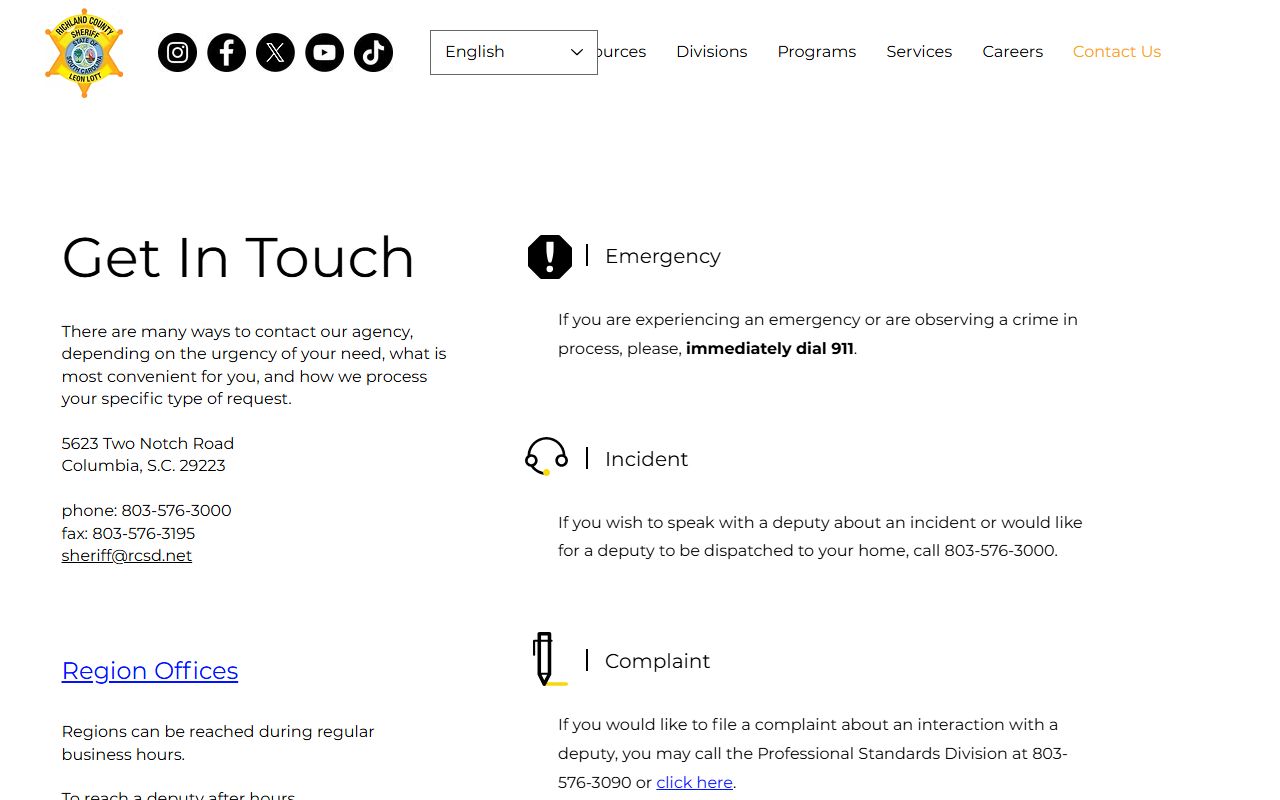
Use the Sheriff's Department contact page to reach the right division or leave an anonymous tip.
The Sheriff's Department runs a Courts division that handles warrant service and court security, listed in the state Sheriffs' Association profile at 803-576-3175. The department also runs civil process and criminal investigations units. When you are not sure which office to call about a warrant, the main line at 803-576-3000 can route you, and the issuing court can confirm whether a warrant is still active.
Warrant and Court Payment Scams
Scammers often use fake warrant threats to take money. The South Carolina Judicial Branch has posted alerts about fraudulent emails and text messages that are not from the courts. The Richland County Probate page has also warned about a fake "final court-ordered mandatory collection notice" text scam. The courts do not ask people to scan a QR code or call a number in an unexpected text to clear a warrant or pay a fine.
If you get a call or text demanding payment to avoid arrest, do not pay. Hang up and call the court directly using a number from an official county or Judicial Branch page.
Bond Court and First Appearance
After an arrest on a warrant, the next step is usually Bond Court. Richland County Bond Court sits at 201 John Mark Dial Drive, the same address as the Alvin S. Glenn Detention Center, with phone 803-576-3281. Bond Court decides whether a person arrested can be released before trial and on what terms. Magistrates set bail, issue many warrants, and hold preliminary hearings, so they sit at the center of the early warrant process.
If a loved one has been picked up on a warrant, the jail detainee lookup is the fastest way to confirm custody, and Bond Court can explain the bond. Bond posting steps were not published in detail on the official pages, so call Bond Court or the detention center before you bring any payment. For the full custody and visitation rules, see the Richland County inmate records page.
Restricted Richland County Warrant Records
Some warrants are not public. Sealed warrants, juvenile matters, and active investigation warrants may be withheld under FOIA when disclosure would interfere with a case or endanger safety. Federal warrants are not in the county or state systems; those involve federal agencies and courts. For a juvenile, records are confidential under the Juvenile Justice Code.
Because of these limits, a clean Public Index search does not always mean no warrant exists. A sealed or very recent warrant may not show in a case docket yet. The only sure way to confirm a warrant is to ask the issuing court or the Sheriff's Department directly. If you are checking on someone else, an attorney can often verify a warrant without exposing you to an arrest at the counter.