
Richland County Circuit Court Overview
South Carolina runs a unified court system, and the Circuit Court is its general-jurisdiction trial court. In Richland County, the Circuit Court handles major civil lawsuits, felony and serious criminal cases, and appeals from Probate, Magistrate, and Municipal courts under its limited appellate role. Its civil division is the Court of Common Pleas; its criminal division is the Court of General Sessions.
Richland County is part of the Fifth Judicial Circuit. Circuit Court judges serve circuits on a rotating basis, with terms and assignments set through Court Administration and the Chief Justice. Most Circuit Court business runs through the Richland County Judicial Center at 1701 Main Street, where the Clerk of Court keeps the case files. Common Pleas civil records sit in Room 205, and General Sessions criminal records are on the 4th floor of the same building.
The South Carolina Judicial Branch Circuit Court page is shown below.
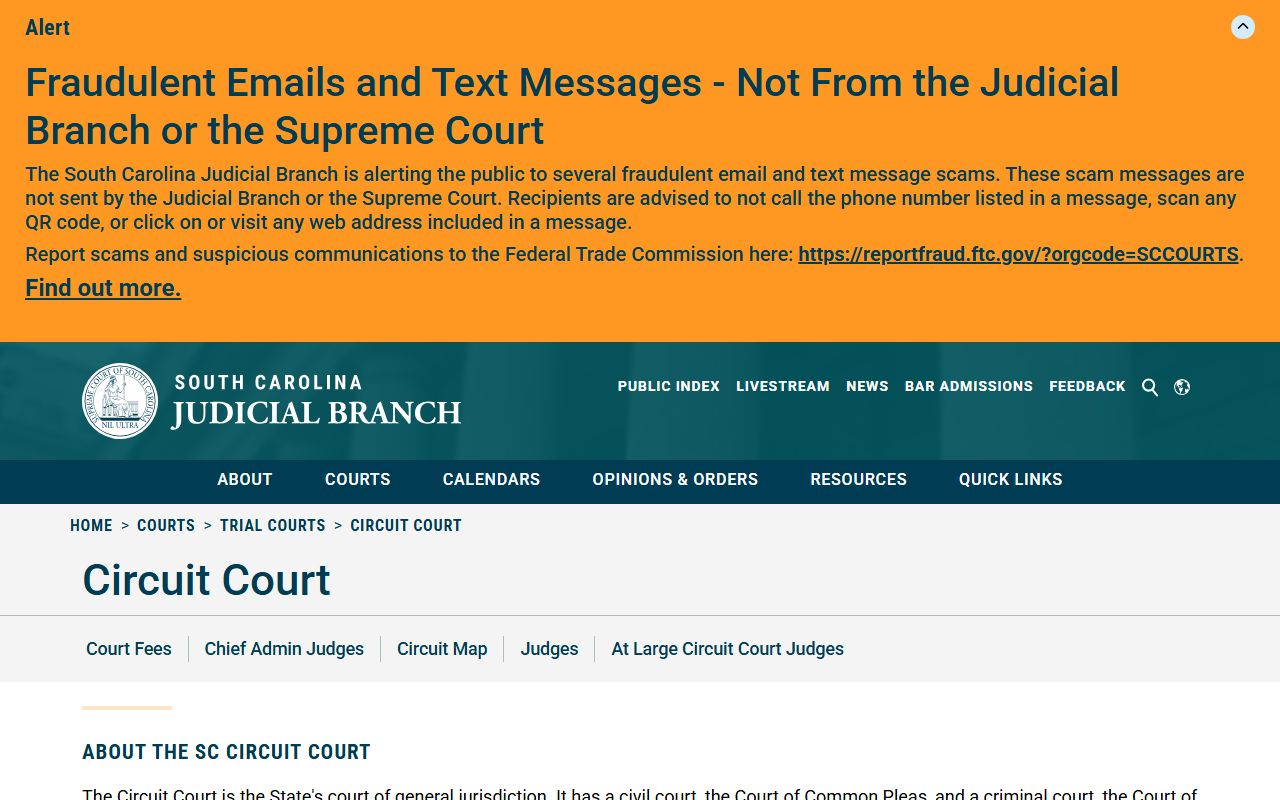
The Circuit Court page explains the court's civil and criminal divisions across the state.
How to Search Richland County Circuit Court Cases
Circuit Court cases are searched through the South Carolina Judicial Branch Public Index for Richland County. Common Pleas civil cases and General Sessions criminal cases both appear there, where they are not restricted. Search by case number when you have it, since the number codes the court and the county. A case number that starts with the year and then CP marks Common Pleas, while GS marks General Sessions.
The portal needs cookies and JavaScript turned on, and some browsers need a pop-up exception to open case detail. For a name search, enter a last name, then add a first name and a filing-date range to narrow the list. The index shows the docket, but certified copies still come from the Clerk of Court. For the full walkthrough, see the Richland County court records page.
Richland County Circuit Court and Related Offices
South Carolina does not number its circuit courts the way some states do. Instead, the work splits by division and by office. The table below lists the main Richland County court offices, with the addresses and phone lines for each.
| Court / Division | Location | Phone |
|---|---|---|
| Common Pleas (Clerk of Court) | 1701 Main St., Room 205, Columbia | 803-576-1950 |
| General Sessions | 1701 Main St., 4th Floor, Columbia | 803-576-1950 |
| Master-in-Equity | 2500 Decker Blvd., Courtroom 1, Columbia | 803-576-1900 |
| Bond Court | 201 John Mark Dial Dr., Columbia | 803-576-3281 |
| Central Court Magistrate | 2500 Decker Blvd., Columbia | 803-576-2300 |
Family Court and Probate Court are separate trial courts in the same county; see the marriage and divorce and probate records pages for those.
Circuit Court vs. Magistrate vs. Municipal Court
The trial courts split by how serious a case is and where it happens. The Circuit Court takes the largest civil cases and the most serious crimes. Magistrate and Municipal courts are summary courts that handle smaller matters. The comparison below shows the main lines.
| Circuit Court | Magistrate Court | Municipal Court | |
|---|---|---|---|
| Civil Limit | Large civil over $7,500 | Up to $7,500 | Generally none |
| Criminal Jurisdiction | Felonies and serious crime | Up to $500 fine or 30 days | City ordinance and lower crime |
| Warrants / Bail | Tries indicted cases | Issues warrants, sets bail | City-level matters |
| Appeals Go To | Court of Appeals | Circuit Court | Circuit Court |
How a Case Moves Through the Richland County System
Civil and criminal cases follow different paths, but both can end at the Court of Appeals. A criminal case usually starts with an arrest and a bond hearing, then moves through indictment to trial in General Sessions. A civil case starts with a complaint filed in Common Pleas. The two paths rarely cross, since criminal and civil files are kept and searched separately.
Criminal flow: Arrest › Bond Court / Magistrate › Preliminary Hearing › Grand Jury Indictment › Arraignment › Trial (General Sessions) › Sentencing › Appeal
Civil flow: Complaint Filed (Common Pleas) › Answer › Discovery › Mediation › Trial › Judgment › Appeal
Common Pleas and General Sessions Divisions
The two divisions of the Circuit Court keep separate records. Common Pleas hears civil lawsuits, contract and injury disputes, property matters, judgments, and appeals from lower courts. Its rosters include jury, non-jury, motion, and settlement-hearing calendars. The Clerk of Court manages those civil records and schedules.
General Sessions hears felony and serious criminal cases. The official county page names warrants, indictments, sentence sheets, bond papers, and related documents as part of the General Sessions record, all filed with the Clerk. Criminal record copies come from the 4th-floor records department. For the full case search, see Richland County court records.
The prosecutor on the criminal side is the Circuit Solicitor, not a district attorney. The Fifth Circuit Solicitor is the chief prosecutor handling criminal cases for the State across Richland and Kershaw counties. On the defense side, the Richland County Public Defender represents qualifying defendants, and indigent screening decides who qualifies. So a single General Sessions case can involve the Clerk for records, the Solicitor for the State, and the Public Defender for an indigent defendant.
The Fifth Judicial Circuit
Richland County sits in the Fifth Judicial Circuit, together with Kershaw County. In the statewide case index, Richland is Circuit Number 5 and County Number 40, which is why a case number like 2025CP4001973 codes the county. Circuit judges rotate on assignment, so the judge on a given term may change.
Appeals from Richland trial courts generally go to the South Carolina Court of Appeals or the Supreme Court, depending on the case type. Appeals from Magistrate, Municipal, and Probate matters may first go to the Circuit Court under its limited appellate jurisdiction. This is different from the federal path; federal cases for the area run through the U.S. District Court for the District of South Carolina, not the Circuit Court.
Circuit Court Judges and Terms
South Carolina assigns trial judges in a way that differs from many states. Circuit Court judges serve their circuits on a rotating basis, with terms and assignments set through Court Administration and the Chief Justice's assignment authority. That means the judge presiding over a Richland term can change from one session to the next.
Other courts in the county follow their own rules. Family Court has at least two resident judges per circuit and also rotates, mostly within resident circuits. The Probate Judge, Amy McCulloch, is elected locally for a four-year term. Magistrates are appointed to four-year terms by the Governor with the advice and consent of the Senate. Because of this mix of rotation, election, and appointment, the official who hears a matter depends on both the court and the calendar.
Master-in-Equity and Referred Matters
The Master-in-Equity is a division of the Circuit Court for referred equity matters. No case starts there. A Circuit Court Order of Reference sends a case to the Master, who then exercises circuit-judge authority over the referred, non-jury matter. Richland County's Master-in-Equity, Judge Stephanie N. Lawrence, was appointed in March 2025 and sits at Central Court, 2500 Decker Boulevard, phone 803-576-1900.
The Master handles foreclosure, quiet title, partition, supplemental proceedings, and writs of assistance. The Master-in-Equity page is shown below.
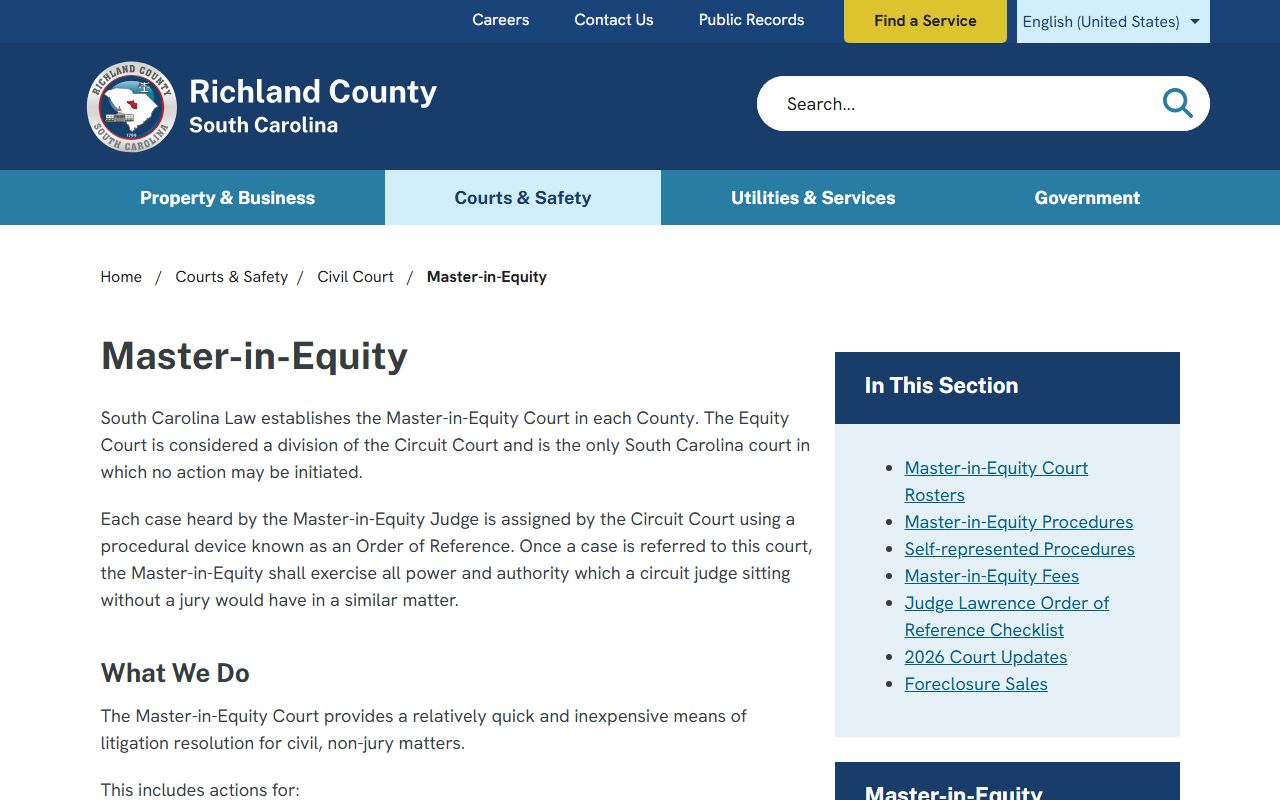
The Master-in-Equity page lists the judge, staff, and procedure links, and notes that its fees are paid separately, not through e-filing.
Magistrate and Lower Courts
Below the Circuit Court are the summary courts. Magistrate Courts handle civil claims up to $7,500, lower-level criminal matters, bail, preliminary hearings, and arrest and search warrants. Richland County has several magistrate offices across the county, including Central Court, Blythewood, Columbia, Dentsville, and Dutch Fork locations. Municipal Courts handle city ordinance, traffic, and lower criminal cases inside city limits, with Columbia Municipal Court listed in the statewide index as available since December 1, 2025.
These courts sit closest to the public, so many small claims, traffic, and bond matters start there rather than at the Circuit Court. Appeals from these summary courts can move up to the Circuit Court. The split also explains why the Clerk of Court cannot run a full background check: the Clerk holds Circuit Court files, but the Magistrate and Municipal cases live with those courts. For a complete criminal history that covers every court, SLED is the official statewide source. So a thorough records search often touches more than one court level.