
South Carolina Freedom of Information Act
South Carolina's Freedom of Information Act, at S.C. Code Title 30, Chapter 4, gives the public a broad right to inspect, copy, or receive non-exempt public records held by public bodies. The law defines a public record broadly as material prepared, owned, used, or kept by a public body. Counties, cities, school districts, and publicly funded bodies are all covered.
Anyone can make a request, and you do not have to explain why you want a record. The act states that public business should be done openly so citizens can learn about their government at minimum cost or delay. The Richland County FOIA information page is the local entry point for these requests, shown below.
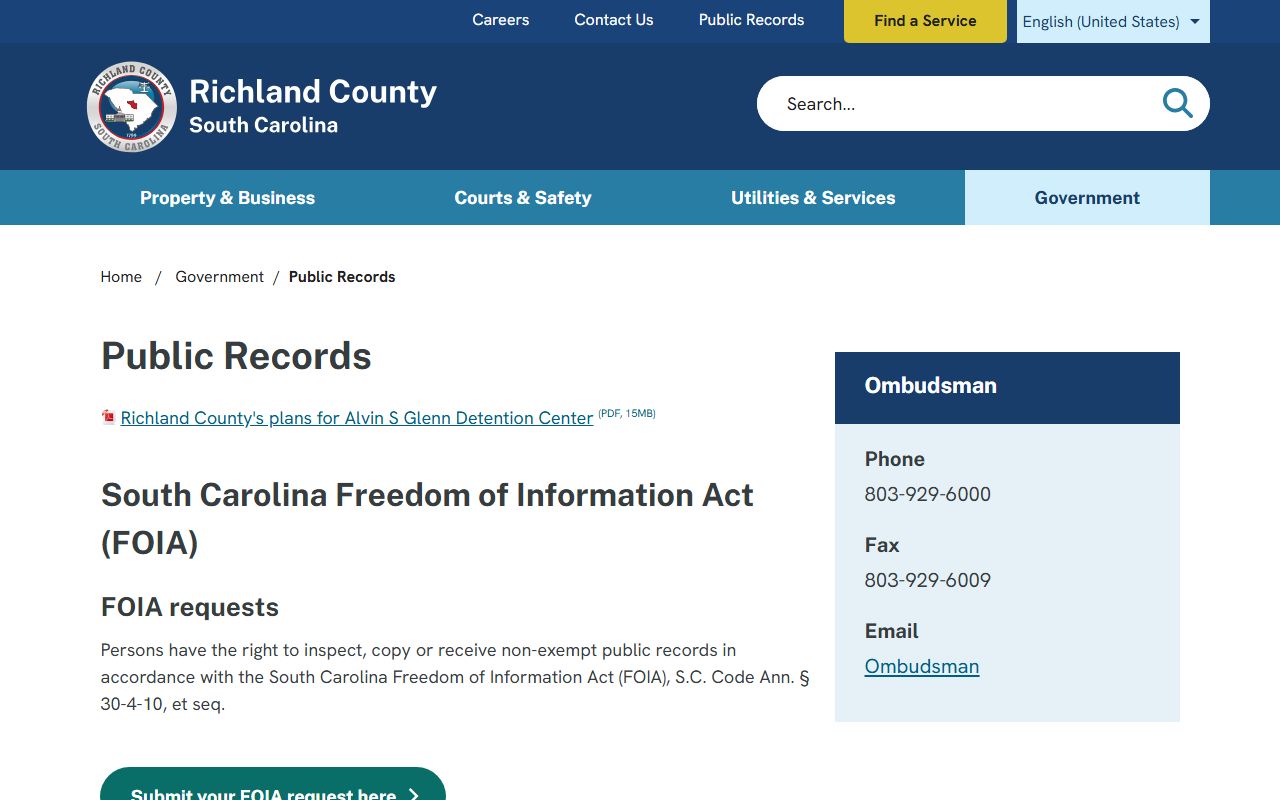
Use the county FOIA page to find the right contact and the current request process.
What Records the County Maintains
Different Richland County offices hold different records. The Clerk of Court keeps Common Pleas civil and General Sessions criminal files, along with Family Court matters. The Register of Deeds area handles deeds, liens, tax liens, mortgages, and powers of attorney. Probate Court keeps estates and marriage licenses. The detention center keeps custody records, and the Sheriff keeps incident and arrest reports.
- Court case records, through the Clerk of Court and the statewide index.
- Deeds, mortgages, liens, and tax liens, through the Register of Deeds.
- Probate estate files and marriage licenses, through Probate Court.
- Jail custody and booking records, through the detention center.
- Incident and arrest reports, through the Sheriff's Department.
Knowing which office holds a record matters, because court case access runs through the index and the clerk, while other county documents go through the FOIA channel. See court records for case files and Clerk of Court for clerk-held documents.
Court Records vs. FOIA Requests
It helps to know the line between a court record and a FOIA request. Trial court case files are reached through the statewide Public Index and the Clerk of Court, not through a FOIA letter. FOIA is the right tool for other county documents, such as budgets, contracts, policies, incident reports, and administrative files. Sending a FOIA request to the court for a case file usually just sends you back to the index or the clerk.
So match the tool to the record. Use the index for a case, the deeds office for property, Probate for an estate, the jail lookup for custody, and a FOIA request for the rest. The South Carolina FOIA also lists certain categories as clearly public under S.C. Code § 30-4-50, including final orders, public expenditure records, and reports describing the nature and location of crimes.
How to File a Public Records Request in Richland County
A FOIA request should be clear and specific. Identify the office, describe the records, and give a date range if you can. A narrow request is usually faster and cheaper than a broad one.
- Identify the right office, since the county clerk, deeds, probate, jail, and sheriff each hold different records.
- Describe the records you want, with names, dates, and a date range when possible.
- Submit the request through the county FOIA channel or directly to the office that holds the records.
- Wait for the office to make its determination within the statutory deadline.
- Pay any allowed fee or deposit, then receive the records in the format provided.
For court case documents, you may not need a FOIA request at all, since the public index and the clerk handle case copies directly.
Public Records Request Fields
Whether you use a form or a letter, include the details below so the office can find the records and reach you.
| Field | Required | Notes |
|---|---|---|
| Requester Name and Contact | Yes | So the office can respond and send a fee estimate. |
| Description of Records | Yes | Be specific; name the office, the subject, and any case or document number. |
| Date Range | No | Narrows the search and can lower the fee. |
| Format Preference | No | Paper, electronic, or inspection in person. |
Response Timelines
FOIA sets deadlines. Under S.C. Code § 30-4-30, a public body must decide on a request within 10 business days for records that are 24 months old or newer, and within 20 business days for older records. After the determination, the law allows production generally within 30 to 35 calendar days, and the office can require a deposit before it starts work.
If the deadline passes with no response, follow up in writing and keep a copy of your original request and the date sent. A clear paper trail helps if you later need to challenge a delay or a denial. The clock starts when the office receives the request, so submit it in a way you can prove, such as email or certified mail.
Public Records Fees in Richland County
FOIA does not set one statewide per-page price. Instead, it allows a reasonable fee that does not exceed the actual cost of searching for, retrieving, and redacting the records, and it requires public bodies to post their fee schedules. The table below shows how those charges are framed; confirm the exact amounts with the office that holds the records.
| Item | Amount |
|---|---|
| Copy charge | Reasonable, not to exceed actual cost |
| Search and redaction time | Actual cost, per the office fee schedule |
| Deposit before work begins | May be required by the office |
| Electronic format | Cost of the medium, where provided |
Some offices set their own posted copy fees. For example, Probate charges $0.50 per page in office, and a Richland marriage certified copy is $8. Court certified-copy fees are set by the Clerk; call to confirm before mailing payment.
Jail Identification Records
FOIA has a specific rule for jails. Under S.C. Code § 30-4-30, documents that identify people confined in a jail, detention center, or prison for the preceding three months must be available for public inspection, unless an exemption applies. That is why recent custody information at the Alvin S. Glenn Detention Center is generally open to the public.
For a live custody check, the jail detainee lookup is faster than a written request. See the Richland County inmate records page for the name-based roster search and the contact details for the detention center.
Rule 610 Judicial Data Requests
Court records follow their own rules in addition to FOIA. A single judicial record is one thing, but bulk distribution or compiled judicial information needs a formal request under Rule 610 of the South Carolina Appellate Court Rules. The rule separates routine public-website searches, which anyone can run, from large compiled data sets, which require a formal request and may carry restrictions.
The Judicial Branch Rule 610 page is shown below.
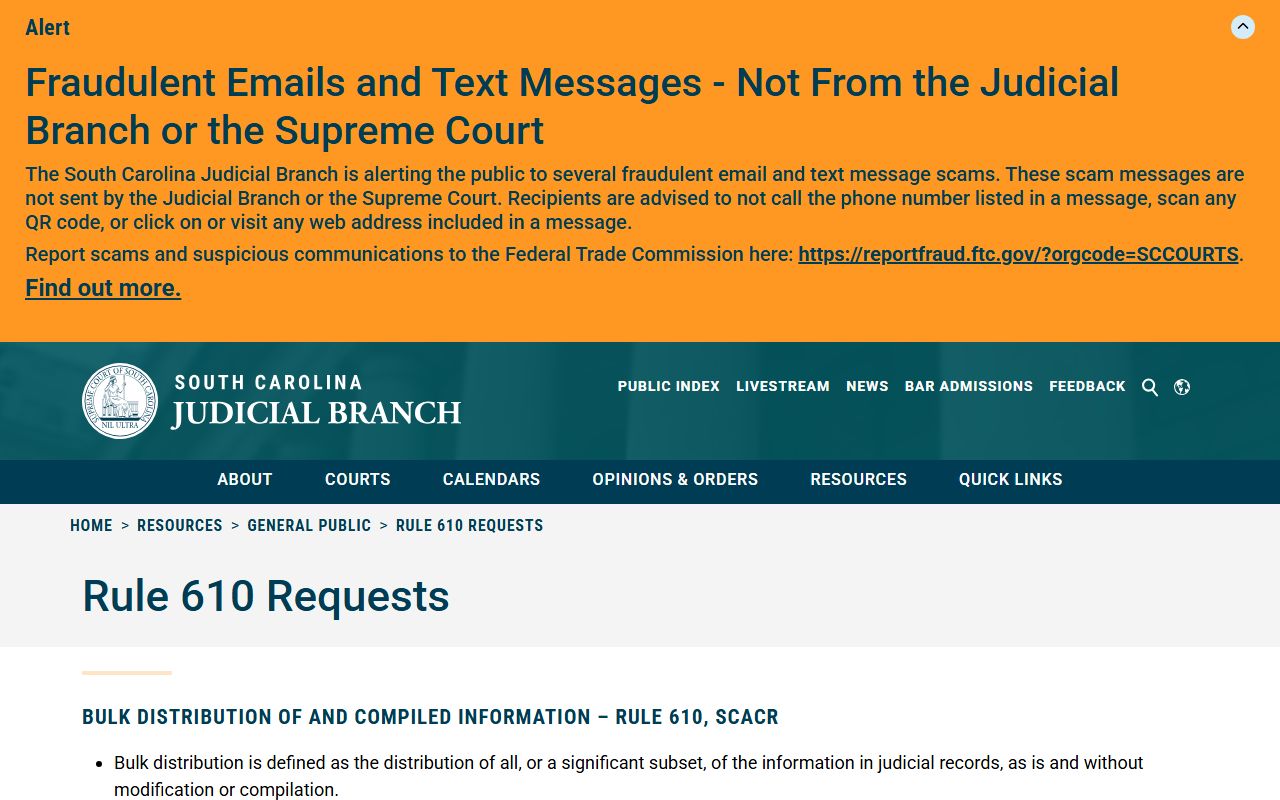
Use the Rule 610 page and its request form for bulk or compiled judicial data, not for a single case lookup.
Records That Are Exempt
Not every record is open. S.C. Code § 30-4-40 lets a public body withhold trade secrets, personal privacy material, certain law-enforcement records where disclosure would interfere with a case, attorney-client and work-product material, and matters closed by other laws. The definitions section also keeps income tax returns, medical records, scholastic records, and adoption records outside FOIA's open-records reach.
Public court systems also redact protected personal identifiers, such as Social Security numbers and protected addresses. When part of a record is exempt, the office may release the rest with the exempt parts removed. An exemption usually lets an office withhold a record; it does not always require it, so it is worth asking whether a partial release is possible. A 2024 update also added limits on certain lottery-prize claim disclosures, a reminder that the exemption list changes over time.
If Your Request Is Denied
If an office denies a request or misses a deadline, ask for the legal basis in writing. FOIA disputes in South Carolina can be pursued in court, and a person may seek a ruling to compel disclosure. Before that step, a clear written request and a documented response often resolve the matter, since many denials come from a vague request rather than a true exemption.
For legal help, the South Carolina Bar Lawyer Referral Service at 803-799-7100 can point you to an attorney. Keep copies of every request and reply so you have a record if you escalate. A short, specific follow-up that quotes your original request and its date often resolves a stalled request without any further action.