
How to Search Richland County Court Records
The main tool is the South Carolina Judicial Branch Public Index. Reach it directly for the county at the Richland County Public Index, or start from the statewide Case Records Search page and pick Richland. The system lists Richland as Circuit Number 5 and County Number 40. It covers Common Pleas civil cases, General Sessions criminal cases, Family Court, Probate, and Magistrate matters, plus Columbia Municipal Court where included.
Before you begin, turn on cookies and JavaScript; the portal will not run without them. If a case detail window fails to open, add a pop-up exception for publicindex.sccourts.org. Have a party name or a case number ready. A case number is the cleanest search, since South Carolina numbers code both the court and the county.
The official Public Index search page for Richland County is shown below, hosted on the South Carolina Judicial Branch site.
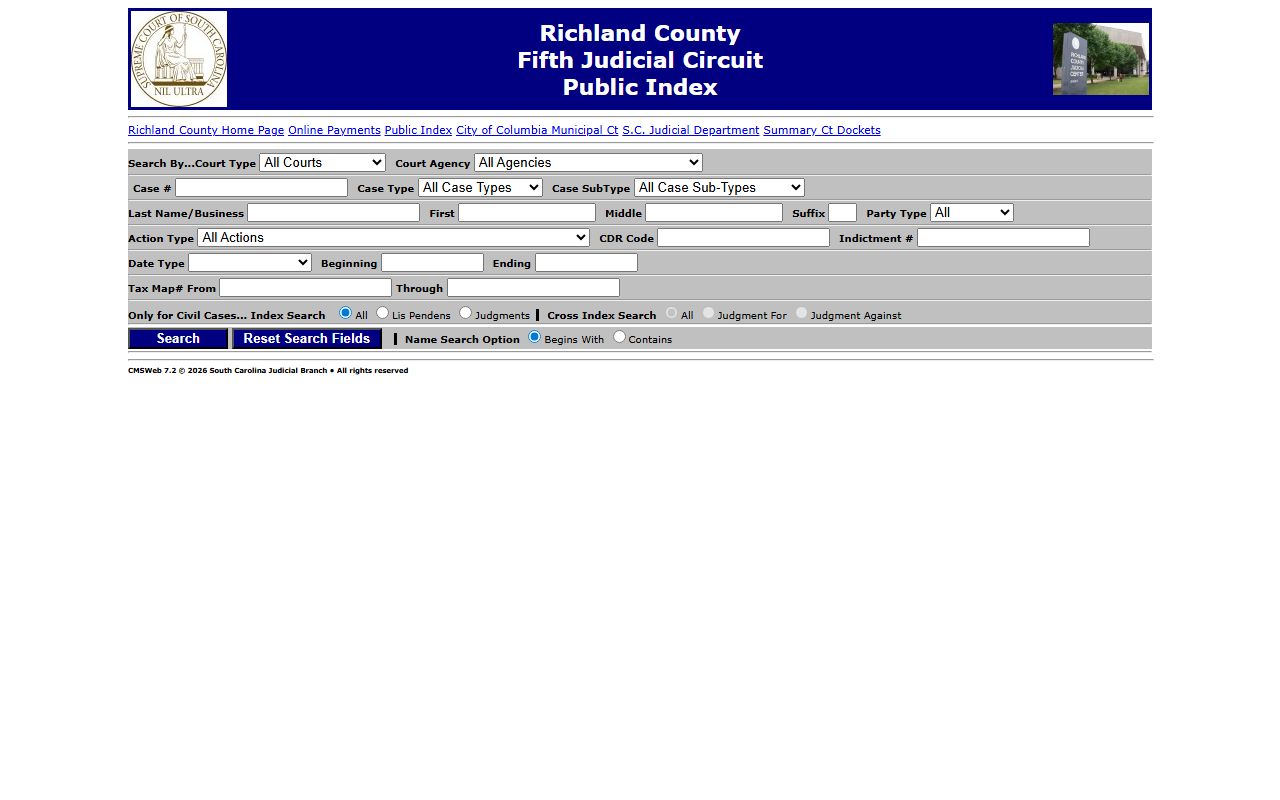
From this page you can run a name or case-number query, then open any public case to read its full docket.
- Open the Richland County Public Index, or select Richland from the statewide page.
- Enable JavaScript and cookies; add a pop-up exception if case windows do not open.
- Choose a court type, or leave it on all courts if you are unsure where the case sits.
- Search by case number, or enter a last name and add a first name and a filing-date range.
- Open a result to view parties, docket actions, hearings, and disposition; request a certified copy from the clerk if needed.
Richland County Court Records Search Fields
The Public Index gives you several fields to focus a search. You do not need to fill them all. A case number alone usually pulls one file. A name search works better when you add a first name and a date range to cut down on people who share a last name. The table below lists the common fields and how each one behaves.
| Field Label | Type | Required | Notes / Format |
|---|---|---|---|
| Court Type | Dropdown | No | All Courts, Circuit, Family, Probate, Magistrate, or Municipal where available. |
| Case Number | Text | No | Year plus court and county code; example 2025CP4001973. |
| Last Name / Business Name | Text | For name search | Used for party, defendant, or business lookups. |
| First Name | Text | No | Narrows a person search. |
| Date Filed From / To | Date | No | Limits results to a filing-date range. |
| CDR Code | Text | No | Charge or case-code filter published by the Judicial Branch. |
Note: Effective January 1, 2026, the public Index display limits home-address information under privacy changes, so verify any address detail with the clerk.
Types of Richland County Court Records
Richland County court records cover the full range of trial-court work. Each court keeps its own files. The Clerk of Court holds Common Pleas civil files and General Sessions criminal files. Family Court keeps domestic cases. Probate Court keeps estates and marriage licenses. Magistrate and Municipal Courts hold small claims, lower-level crime, and many traffic cases. The Master-in-Equity handles referred equity matters such as foreclosure.
Which court produced a record tells you where to get a copy. Docket and index data is searchable through the Public Index, but the actual document copy comes from that court's clerk. For deeper detail, see Richland County Circuit Court and the Clerk of Court page.
- Common Pleas civil lawsuits, judgments, liens, and appeals from lower courts.
- General Sessions felony and serious criminal cases filed with the Clerk.
- Family Court divorce, custody, support, and adoption matters.
- Probate estates, wills, guardianships, and conservatorships.
- Magistrate and Municipal small claims, lower crime, and traffic cases.
What Richland County Court Records Show
A case file in the Public Index holds the core facts of the matter. You will see the case number, the court and division, the parties, and the filing date. The docket lists every action in order, from the first filing to the final order. Criminal files can show charges, bond, plea, and sentence. Civil files show judgments and liens. The table below maps the fields you are most likely to see.
| Field | What It Shows |
|---|---|
| Case Number | Year, court code, county 40, and sequence; example 2025CP4001973. |
| Filing Date | When the case was opened with the clerk. |
| Parties | Plaintiff and defendant, State and defendant, or petitioner and respondent. |
| Judge / Attorneys | The judge of record and the attorneys for each side, where listed. |
| Docket Entries | Each filing, motion, order, hearing, and continuance in date order. |
| Disposition | The final outcome, such as pending, dismissed, disposed, or closed. |
Sealed, juvenile, adoption, and mental-health files are restricted, and protected personal identifiers are redacted.
A few terms come up again and again when you read a Richland County case file. Knowing them up front makes the docket easier to follow.
- Docket
- The dated list of every filing, hearing, and court action in a case.
- Disposition
- The final outcome of a charge or case.
- Nolle prosequi
- A notice that the State has dropped a criminal charge.
- Continuance
- A postponement of a hearing or trial to a later date.
Public Access Framework for Richland County Court Records
South Carolina's Freedom of Information Act, found at S.C. Code Title 30, Chapter 4, gives the public a broad right to inspect and copy records held by public bodies. The right to inspect, the fee limits, and the response deadlines all sit in S.C. Code § 30-4-30. Judicial records also follow court rules; bulk or compiled data requires a formal request under Rule 610, SCACR.
Anyone can use the Public Index; you do not need a reason or an account. For certified copies, you contact the clerk, who may charge a copy fee. A court records search is not the same as a SLED background check. The official FOIA statute page is shown below.
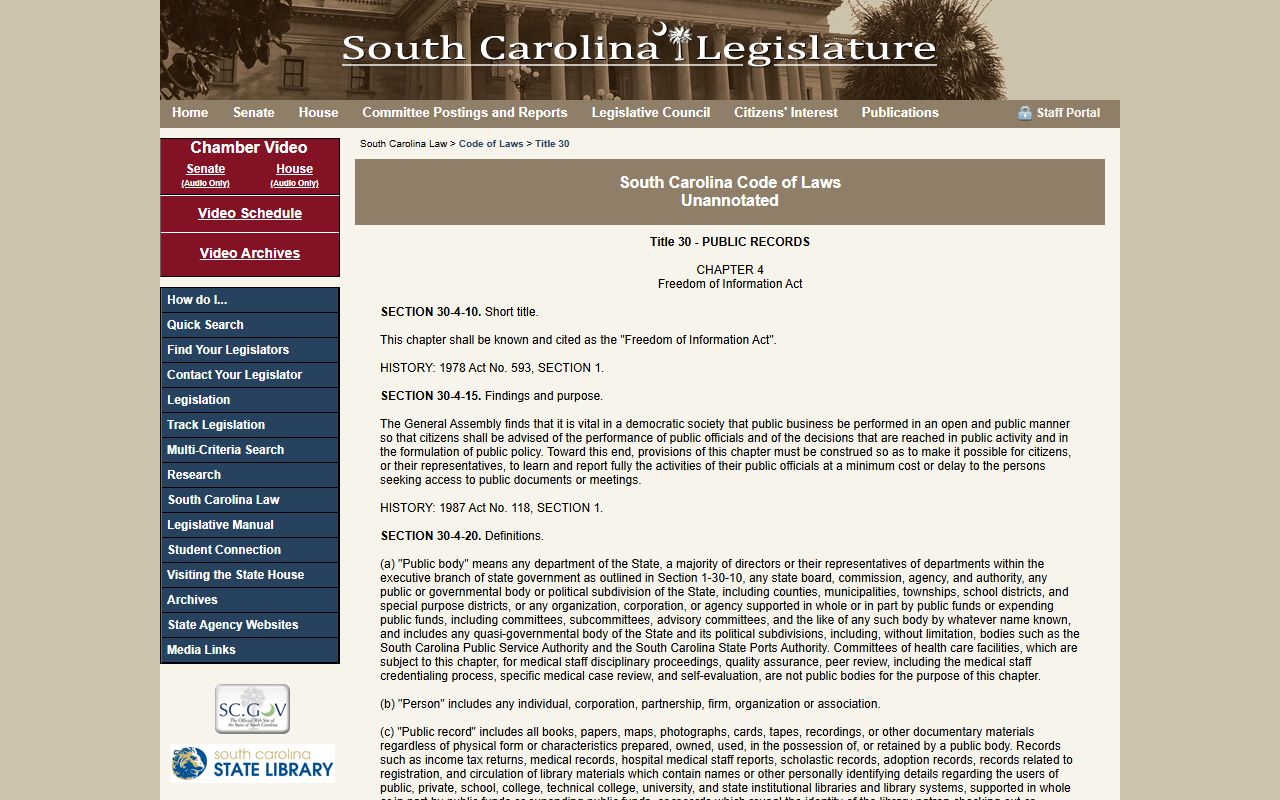
Read the exemptions in S.C. Code § 30-4-40 before you assume a record is open, since some law-enforcement and privacy material can be withheld.
FOIA also sets response timelines for written record requests. A public body has 10 business days to decide on records that are 24 months old or newer, and 20 business days for older records. After that decision, the law allows production within roughly 30 to 35 calendar days, and any fee must stay within actual search, retrieval, and redaction cost. Those deadlines apply to FOIA requests to county offices, not to a self-service Public Index search, which returns results at once.
Records That Are Sealed or Confidential in Richland County
Some Richland County court records are closed by law. Juvenile records are confidential under the Juvenile Justice Code. Adoption records are not open under FOIA. Mental-health and commitment files held by Probate Court stay private. Sealed and expunged records drop out of public view, and the courts redact Social Security numbers, account numbers, and protected addresses.
To view a sealed record, a person usually needs a court order or a clear statutory right of access. Many adult expungements run through the Fifth Circuit Solicitor's office. For criminal records and charge-versus-conviction questions, see the Richland County arrest records page.
In-Person Court Record Requests
When you need a certified copy or a document not posted online, go to the clerk for that court. The Clerk of Court is at the Richland County Judicial Center on Main Street, with General Sessions criminal records on the 4th floor. Bring a photo ID and the case number, and confirm accepted payment before you arrive. Expungement-order payments must be a postal money order or cashier's check.
Richland County Clerk of Court
1701 Main St., Room 205
Columbia, SC 29201
803-576-1950
Mon-Fri 8:30 a.m.-5 p.m.
Mailed criminal-record requests go to Richland County Clerk of Court, Attn: Criminal Records, P.O. Box 2766, Columbia, SC 29202. The Family Court mailing address is P.O. Box 192, Columbia, SC 29202. Keep in mind the Clerk does not run a full certified criminal background check, since its records leave out Magistrate and Summary Court cases; for that, contact SLED. Call ahead to confirm the per-copy fee, because the Clerk's certified-copy rate is not posted online.
Older and Offline Richland County Records
Not every Richland County court record lives online. The Public Index reaches back only so far, and older files may sit in paper or microfilm. Probate estate records run from 1900 to the present, with 1900 through 1982 on microfilm and files since 1983 scanned for public computers in the Probate office. Divorce decrees split by year at the Clerk: 2005 and prior decrees go through one phone line, while 2006-and-later divorce, name change, and child support questions go through another.
If a case does not appear in the Public Index, it may belong in Magistrate Court, Columbia Municipal Court, a SLED criminal history, Probate subscription records, a restricted Family Court file, or federal PACER. Older estate numbers from before 1983 are found in index books at the Probate office; staff can pull files since 1983 by computer. For estate copies and the subscription option, see the Richland County probate records page.