
How to Search Richland County Traffic Court Records
Most Richland County traffic cases can be found through the South Carolina Judicial Branch Public Index, where participating courts post their cases. Columbia Municipal Court is listed as available in the statewide system as of December 1, 2025. The Judicial Branch also offers a traffic ticket search and payment option through its quick links, which is separate from the general Public Index. Start from the statewide Case Records Search page and pick Richland County.
Before you start, have the citation number, the driver's name, or a date of birth ready. A citation number is the cleanest search. Turn on cookies and JavaScript, and add a pop-up exception if a case detail window does not open.
- Open the Richland County Public Index, or the Judicial Branch traffic ticket search.
- Enter the citation number, or the driver's last and first name.
- Narrow by court type or filing date if the result list is long.
- Open the case to review the charge, court date, and disposition.
- Pay, contest, or request a certified copy through the right court.
Which Courts Handle Traffic Cases in Richland County
Traffic cases split by where the stop happened. A ticket written inside a city limit usually goes to that city's Municipal Court, while a ticket on a county road or highway usually goes to a Magistrate Court. The Circuit Court does not hear routine traffic tickets, though serious related crimes can move up to General Sessions.
Columbia Municipal Court handles tickets inside Columbia city limits and appears in the statewide index. Magistrate offices across the county handle tickets outside the cities. The table below shows the main paths.
| Court | Traffic Cases Handled | Location |
|---|---|---|
| Columbia Municipal Court | Tickets inside Columbia city limits | Columbia city |
| Central Court Magistrate | County-road and highway tickets | 2500 Decker Blvd., Columbia |
| Columbia Magistrate | County-area traffic and summary cases | 3875 Lucius Rd., Columbia |
The South Carolina Judicial Branch Municipal Court page is shown below.
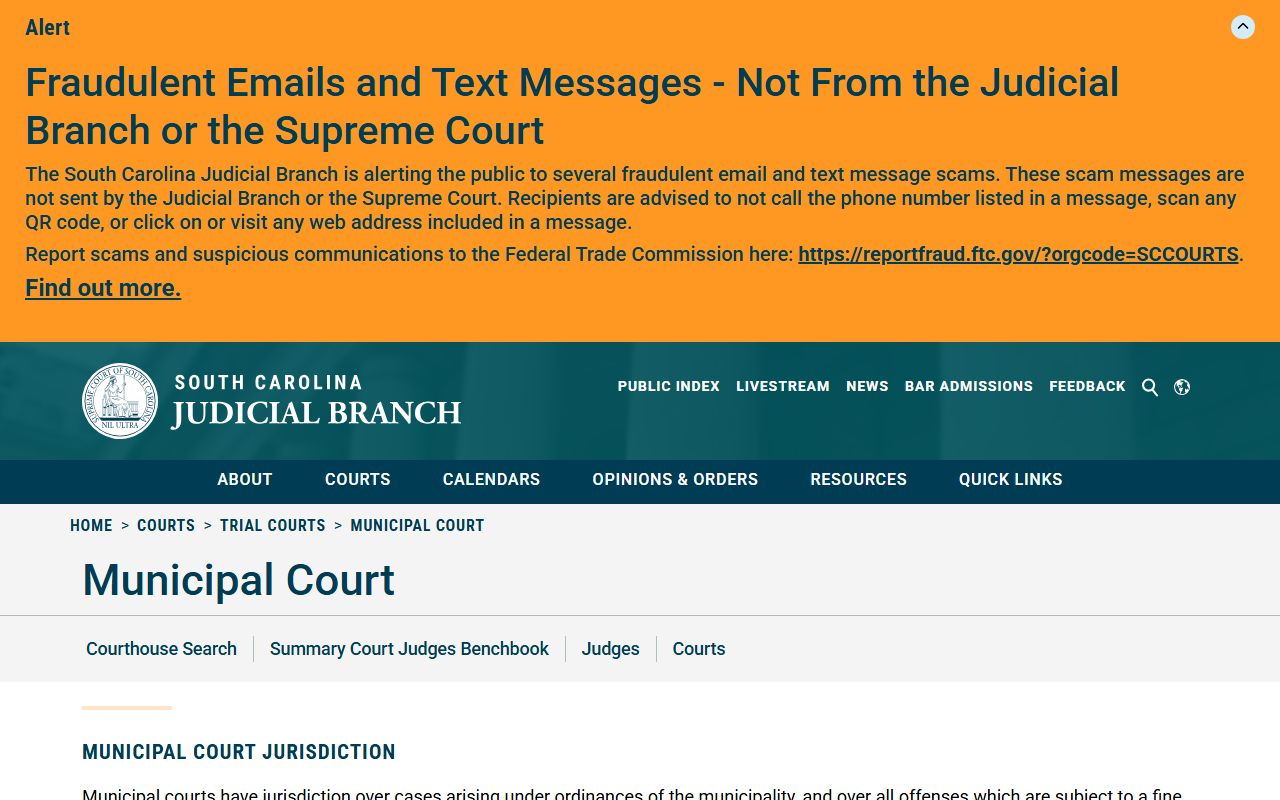
The Municipal Court page and the Magistrate Court page explain how summary courts handle traffic and lower criminal matters.
Types of Traffic Cases on Record
Traffic records cover a range of violations, from minor to serious. Most are heard in summary court, but the most serious driving crimes route to the criminal court instead. The categories below show the spread.
- Moving violations - speeding, running a light, or unsafe lane changes.
- Non-moving and equipment - registration, insurance, or equipment violations.
- Failure to appear - missing a court date, which can lead to a bench warrant.
- Commercial vehicle and CDL - violations by commercial drivers, with stricter rules.
- Serious driving crimes - DUI and reckless driving, which route toward criminal court.
What Richland County Traffic Court Records Show
A traffic case record holds the facts of the citation and the outcome in court. It does not show your license points or status, since those sit on the separate state driver record. The table below maps the fields you are likely to see in a court traffic file.
| Field | What It Shows |
|---|---|
| Citation Number | The number printed on the ticket. |
| Charge / Statute | The violation and the code section behind it. |
| Court | The Magistrate or Municipal court hearing the case. |
| Court Date | When the case is set or was heard. |
| Disposition | The outcome: paid, dismissed, found guilty, or pending. |
| Fine Amount | The fine and court costs, where assessed. |
Points and license status appear on the state driver record, not in the court file, so check both if you need the full picture.
Searching by Citation Number vs by Name
A citation number is the most precise search, since it points to one ticket. A name search casts a wider net and can return several people who share a name, so add a first name or a date range to narrow it. If a citation number search fails, check for typos and confirm the court that issued the ticket. The fields below are the ones you use in the index.
| Search Field | Type | Required | Notes / Format |
|---|---|---|---|
| Citation / Case Number | Text | No | Cleanest search; use the number from the ticket. |
| Last Name | Text | For name search | Add a first name to narrow results. |
| Court Type | Dropdown | No | Magistrate or Municipal, where available. |
| Date Filed Range | Date | No | Limits results to a filing window. |
Paying or Contesting a Richland County Traffic Ticket
You can usually pay a ticket, or you can contest it in court. Paying a ticket is often treated as a guilty plea, which can add a conviction to your driver record, so think before you pay. The Judicial Branch traffic ticket option lets some tickets be paid online; others must be handled at the issuing court.
- Find the ticket and the issuing court through the Public Index or the traffic ticket search.
- Decide whether to pay, which may count as a guilty plea, or to contest the charge.
- To contest, request a court date with the Magistrate or Municipal court that issued the ticket.
- Appear on the court date, or follow the court's instructions for any remote option.
- If found not guilty or the case is dismissed, no conviction is added to the driver record.
If you miss a court date, the court can issue a bench warrant, so handle a ticket before its deadline. See the Richland County warrant records page if a failure-to-appear warrant is a concern.
Public Access Laws for Traffic Court Records
Traffic court records follow the same open-records framework as other court records. South Carolina's Freedom of Information Act gives the public a right to inspect non-exempt records, and the statewide case index makes participating traffic cases searchable. Motor-vehicle offenses and certain expungement paths are set in the state's motor vehicle code.
Key Statutes:
S.C. Code Title 56, Chapter 5 - Sets motor vehicle and traffic offenses, with some expungement references.
S.C. Code Title 30, Chapter 4 - The Freedom of Information Act, governing public access to records.
The South Carolina motor vehicle statute page is shown below.
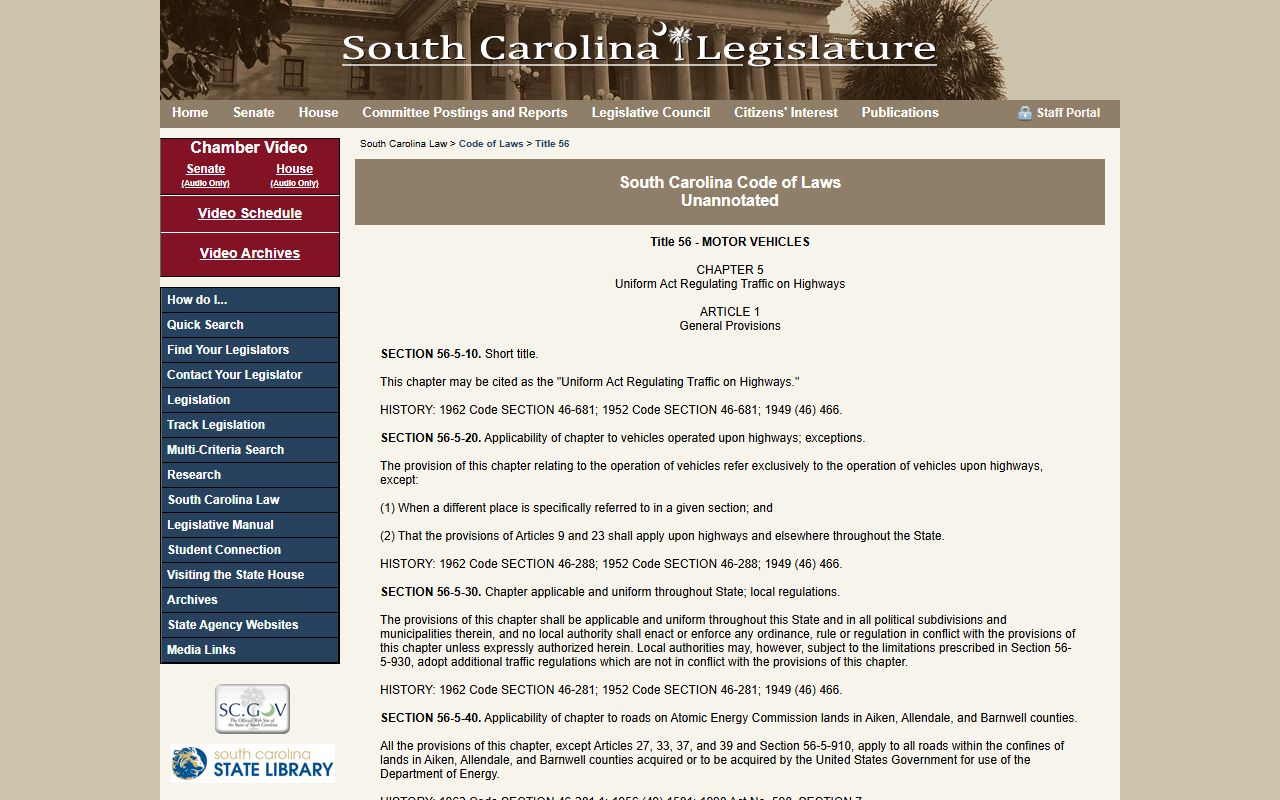
Use the motor vehicle code to find the statute behind a charge listed in a traffic record.
Court Traffic Records vs State Driver Records
This is the most important distinction on the page. The court traffic record is the case file held by the Magistrate or Municipal court. The state driver record is a separate file kept by the South Carolina Department of Motor Vehicles, and it shows convictions, points, and license status. One is the court case; the other is your driving history.
| Record Type | Source | What It Shows | How to Access |
|---|---|---|---|
| Court Traffic Record | Magistrate or Municipal court | Citation, charge, court date, disposition, fine | Public Index or the issuing court |
| State Driver Record | SC Department of Motor Vehicles | Conviction history, points, license status | SCDMV driver record request |
To fix an error in a court file, contact the issuing court; to fix a driving-history error, contact the SCDMV.
CDL and Commercial Driver Records
Commercial driver's license holders face stricter rules. Many violations that a regular driver could resolve quietly can affect a CDL holder's certification, and federal rules require certain convictions to be reported to the driver's record. CDL holders often cannot use the same ticket-reduction options available to other drivers, and some violations carry mandatory consequences for the commercial license.
Because the stakes are higher, a CDL holder should read the charge carefully and consider legal advice before paying a ticket, since a quick payment can count as a conviction on the commercial record.
DUI and DUAC Cases
DUI is a criminal matter, not a routine traffic ticket. A first-offense DUI may be heard in a summary court, while more serious DUI charges, including felony DUI, route to the Court of General Sessions. These cases carry criminal penalties well beyond a traffic fine, and they involve both the court file and the state driver record.
For full Richland County DUI case information, see Richland County arrest records, which covers criminal charges and how to find them.
Ticket Reduction and Driving Options
Drivers sometimes have options to limit the effect of a ticket. A court may allow a reduced charge, and some drivers complete a defensive driving course where the court permits it. These choices can affect whether a conviction lands on the state driver record, which in turn affects points and insurance.
Because eligibility depends on the charge, the court, and the driver's history, confirm any option with the issuing Magistrate or Municipal court before you rely on it. What is offered for one ticket may not be offered for another.
Sealing or Expunging Traffic Records
South Carolina uses a statute-specific expungement system. Certain first-offense summary-court convictions may be eligible for expungement under S.C. Code Title 22, Chapter 5 after waiting periods and conditions, and the motor vehicle code includes some traffic-related expungement references. Eligibility depends on the specific offense and outcome.
Many adult expungements run through the circuit solicitor's office. A non-conviction outcome, such as a dismissal, may be handled differently from a conviction. Because the rules are narrow, check the exact statute for the charge before assuming a traffic record can be cleared.
Fees for Traffic Record Copies
Copy fees depend on the court and the record type. Court copy fees were not posted on the county pages reviewed, so confirm them with the issuing court. The state driver record carries its own fee set by the SCDMV.
| Item | Amount |
|---|---|
| Plain copy per page | Call the issuing court; not published online |
| Certified copy per page | Call the issuing court; not published online |
| Records search | Public Index search is free |
| State driver record | SCDMV fee applies; check the SCDMV |