
How to Search Richland County Court Records
Most Richland County court records are searched through the South Carolina Judicial Branch Public Index. You can reach it directly for Richland County at the Richland County Public Index, or start at the statewide Case Records Search page and pick Richland County. Richland is Circuit Number 5 and County Number 40 in that system. The index covers Common Pleas civil cases, General Sessions criminal cases, Family Court, Probate, Magistrate matters, and Columbia Municipal Court where included.
Before you start, turn on cookies and JavaScript. Some browsers also need a pop-up exception to open case detail windows. Have a name or case number ready. South Carolina case numbers pack in the year, court code, and county code, so a number like 2025CP4001973 is the cleanest way to find one file fast.
- Open the Richland County Public Index, or select Richland from the statewide Case Records Search page.
- Enter a last name or business name. Add a first name and a filing-date range to cut down on false hits.
- Pick a court type, or leave it on all courts if you are not sure where the case sits.
- Review the result list, then open the case detail to read parties, docket actions, hearings, and disposition.
- For a certified copy, contact the matching Clerk division; criminal copies come from the 4th-floor Criminal Records department.
The county's own Richland County homepage links its courts, detention, and public-records pages from one place. The screenshot below shows the official county portal where the Courts & Safety and FOIA links live.
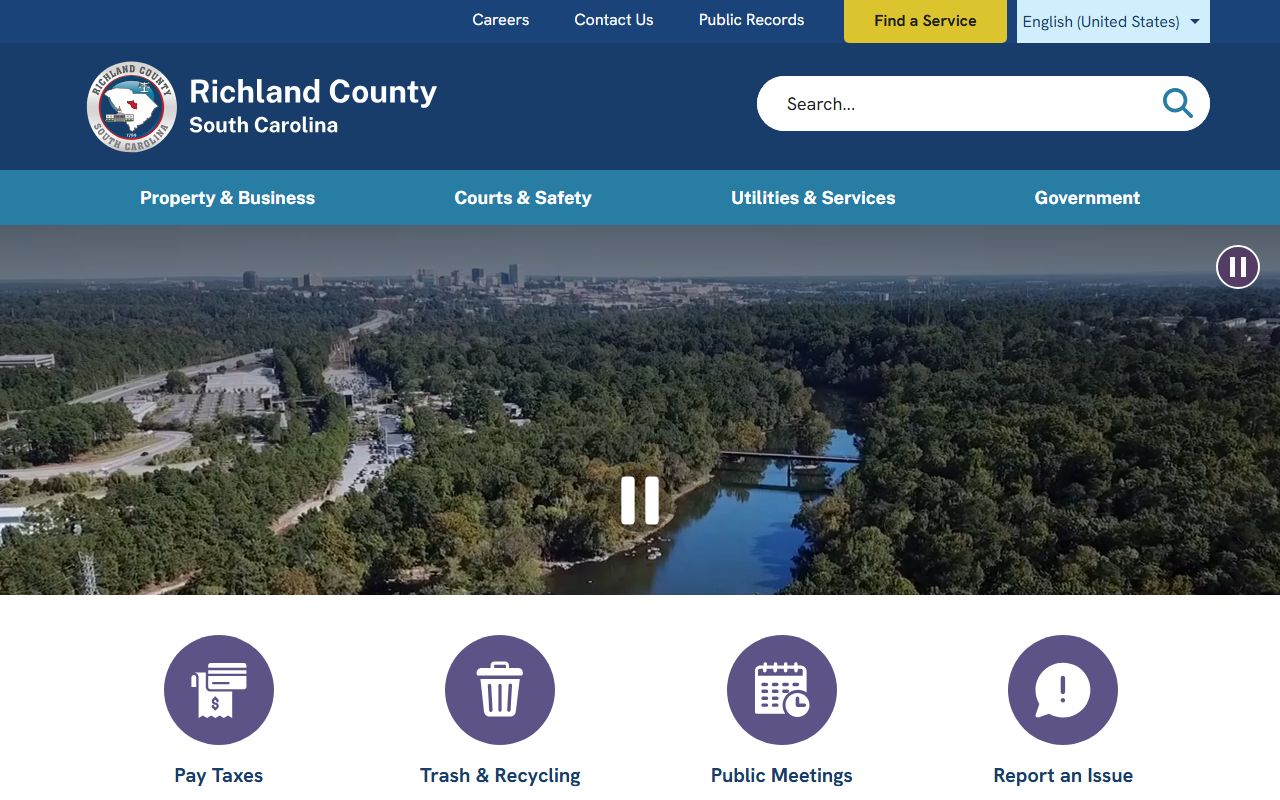
Start at the county site when you are unsure which office holds a record, then move to the statewide index for the actual case search.
The Richland County Judicial System
South Carolina runs a unified, statewide court system. At the top is the Supreme Court, then the Court of Appeals. Below them, the Circuit Court is the main trial court for serious matters. Its civil side is the Court of Common Pleas; its criminal side is the Court of General Sessions. Richland County is part of the Fifth Judicial Circuit, which it shares with Kershaw County. Family Court, Probate Court, Magistrate Court, and Municipal Court each handle their own case types.
Circuit and Family Court judges rotate on assignment through Court Administration and the Chief Justice. The Probate Judge is elected locally for a four-year term; Richland's Probate Judge is Amy McCulloch. Appeals from Magistrate, Municipal, and Probate matters can go first to Circuit Court under its limited appellate role.
Case flow: Summary Court (Magistrate / Municipal) › Circuit Court › Court of Appeals › Supreme Court
| Court | Jurisdiction | Case Types |
|---|---|---|
| Circuit Court | General jurisdiction trial court | Major civil (Common Pleas), serious crime (General Sessions) |
| Family Court | Statewide domestic relations court | Divorce, custody, child support, adoption, most juvenile matters |
| Probate Court | County-level court | Estates, marriage licenses, guardianships, commitments |
| Magistrate Court | County summary court | Small claims up to $7,500, lower crime, warrants, bail |
| Municipal Court | City summary court | City ordinance, traffic, lower criminal cases |
The county's Magistrates page lists Richland's magistrate offices, judges, and phone numbers across the county. The image below shows that magistrate directory.
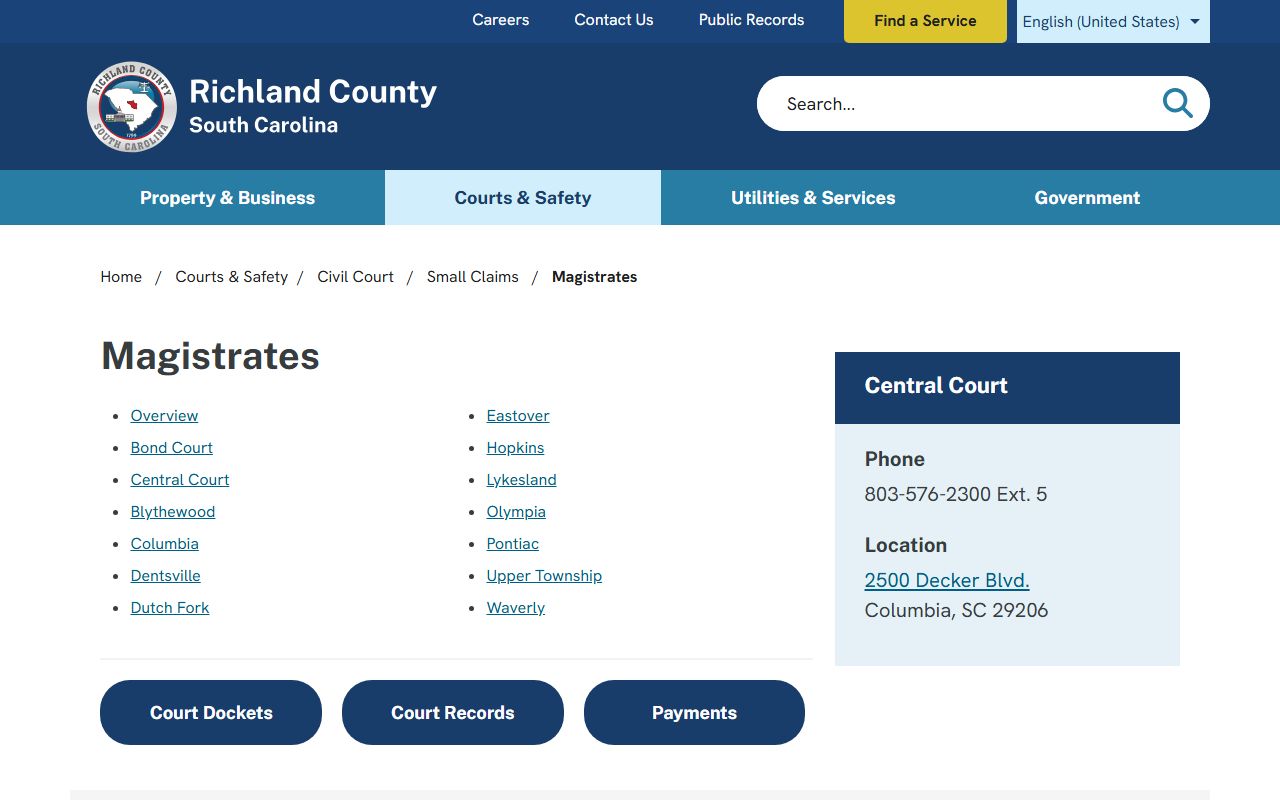
Magistrate Courts sit closest to the public, so many small claims, bond, and warrant questions start at one of these local offices.
Richland County Courthouses
Court business is split across three main sites. The Richland County Judicial Center at 1701 Main Street is the home of the Clerk of Court, Common Pleas, General Sessions records, Family Court, and Probate Court. Central Court at 2500 Decker Boulevard houses Magistrate Court and the Master-in-Equity. Bond Court shares the Alvin S. Glenn Detention Center address on John Mark Dial Drive. Knowing which building holds your record saves a wasted trip downtown.
Richland County Central Court
2500 Decker Blvd.
Columbia, SC 29206
803-576-1900
Bond Court / Detention Center
201 John Mark Dial Dr.
Columbia, SC 29209
803-576-3281
The official Clerk of Court page for Jeanette McBride lists the Judicial Center address, office hours, and the Common Pleas, General Sessions, and Family Court divisions. The screenshot below is that page.
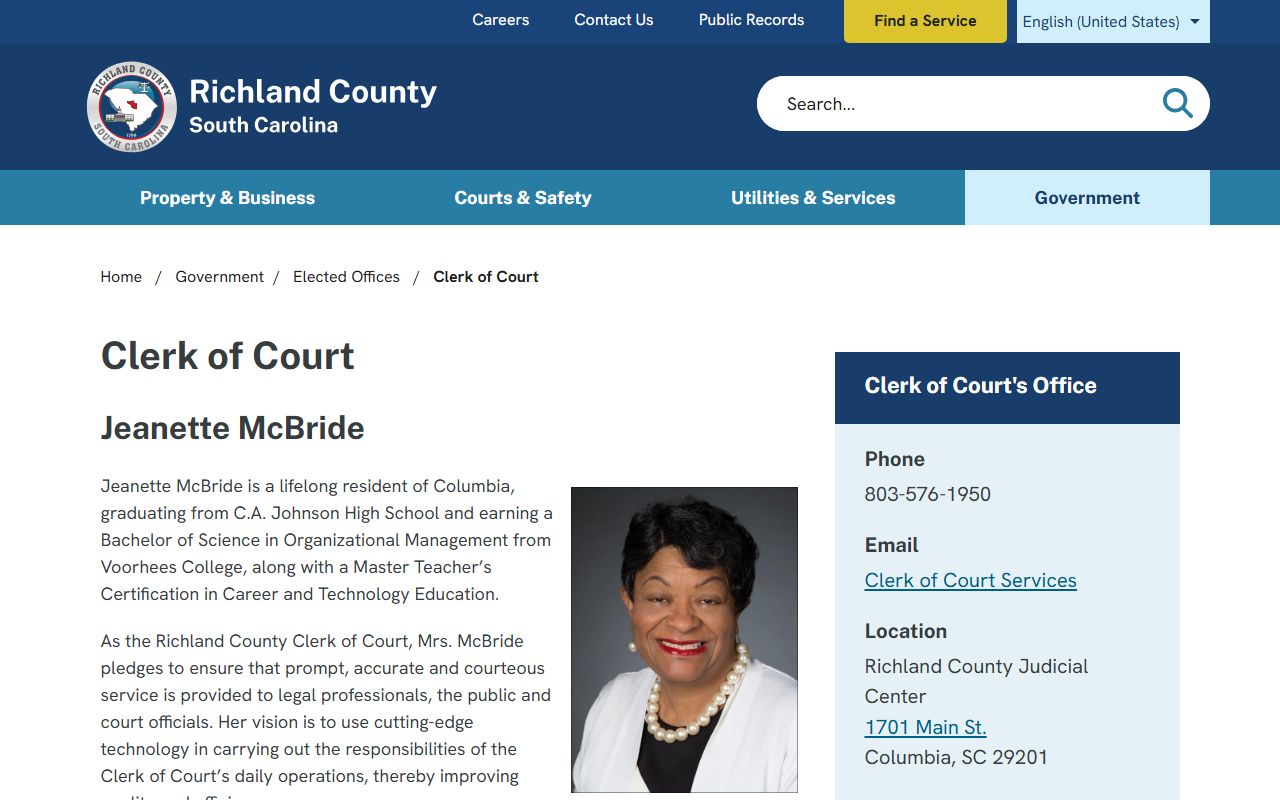
The Clerk's office on Main Street is the first stop for most certified court-record copies in Richland County.
Types of Court Records Available in Richland County
Richland County court records span several courts. The Clerk of Court holds Common Pleas civil files and General Sessions criminal files. Family Court keeps divorce, custody, support, and adoption matters. Probate Court keeps estates and marriage licenses. Magistrate and Municipal Courts hold small claims, lower-level crime, and many traffic cases. Each court controls its own files, so the place you look depends on the case type.
Most docket and index data is public through the statewide Public Index. Document copies and certified copies come from the clerk for that court. Some records, like juvenile, adoption, and sealed files, stay closed.
- Criminal records - General Sessions felony files and Magistrate or Municipal lower-level cases.
- Civil records - Common Pleas lawsuits, judgments, liens, and Master-in-Equity foreclosure matters.
- Family and divorce records - divorce, custody, support, and adoption handled in Family Court.
- Probate records - estates, wills, guardianships, and marriage licenses.
- Traffic records - citations handled in Magistrate or Columbia Municipal Court.
The county's Civil Court page describes Common Pleas, Small Claims, Master-in-Equity, and civil records access. That landing page is shown below.
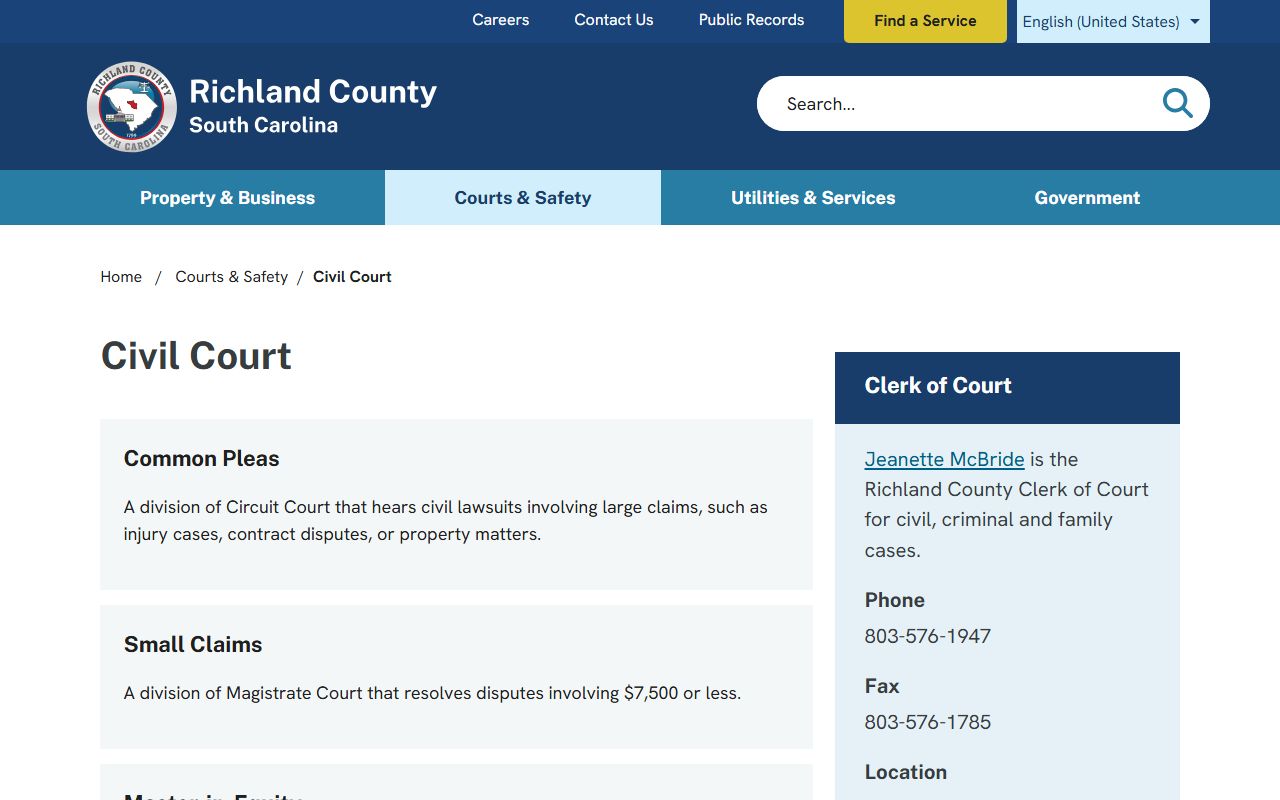
Use the Civil Court page to tell whether your matter belongs in Common Pleas, Small Claims, or the Master-in-Equity.
What Richland County Court Records Show
A Richland County court record holds the basic facts of a case. You will see the case number, the court and division, the parties, the filing date, and the case type. The docket lists each action, from the first complaint or warrant through the final order. Criminal files may show charges, bond, plea, and sentence. Civil files show judgments and liens. Some fields, like home addresses and Social Security numbers, are redacted under current privacy rules.
| Field | What It Shows |
|---|---|
| Case Number | Year, court code, and county 40; example 2025CP4001973. |
| Filing Date | When the case was opened with the clerk. |
| Parties | Plaintiff and defendant, or State and defendant, or petitioner and respondent. |
| Charges / Cause | The criminal charge or the civil claim behind the case. |
| Disposition | The outcome: pending, dismissed, disposed, or closed. |
| Sentence / Judgment | The penalty after conviction, or the money judgment in a civil case. |
The Common Pleas page shows how civil rosters, scheduling, and clerk records tie together. It is shown below.
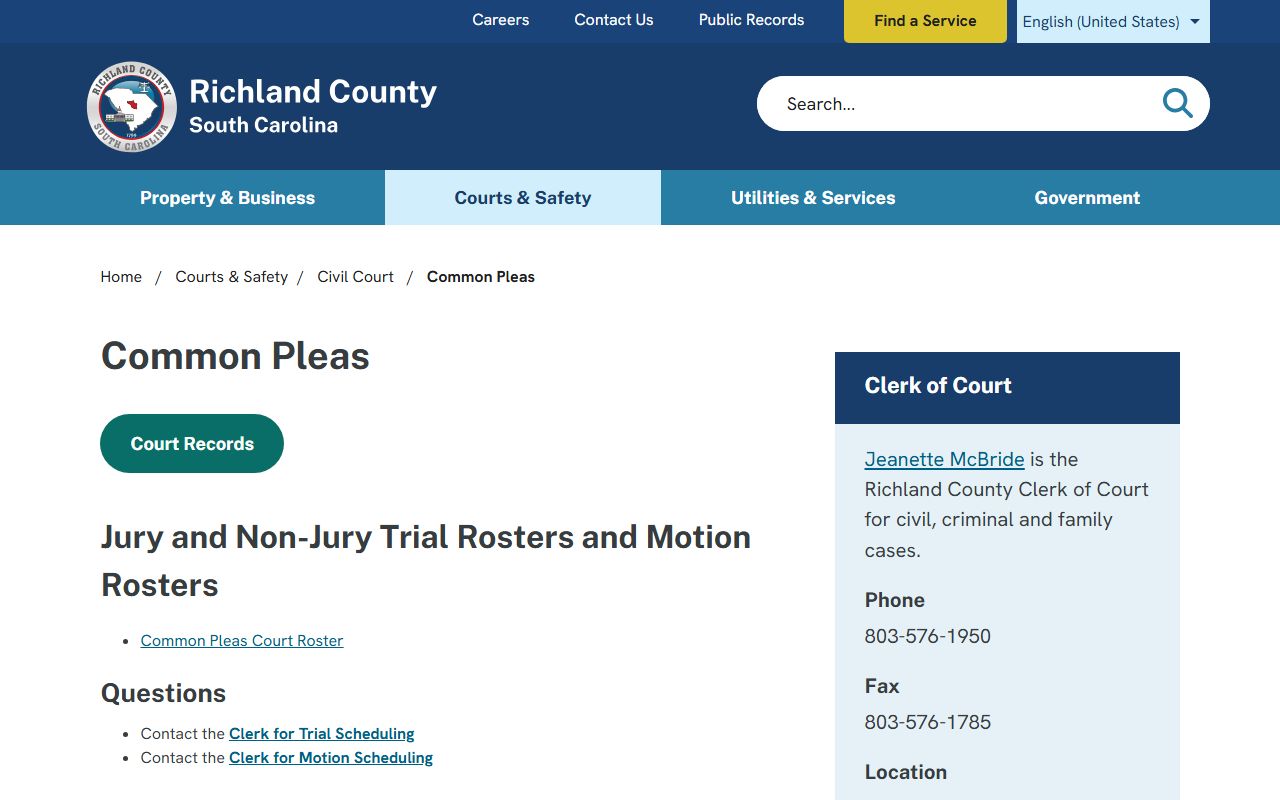
The same field set carries over to Richland County court records across most of the trial courts.
Public Access Laws for Richland County Court Records
South Carolina's Freedom of Information Act gives the public a broad right to inspect and copy records held by public bodies, unless a law exempts them. Court case access works a bit differently from a FOIA request: trial court dockets come through the Public Index, while judicial bulk data follows Rule 610. A SLED criminal-history check is yet another path. The statutes below frame how access and fees work in Richland County and across the state.
Key Statutes:
S.C. Code § 30-4-30 - Gives the right to inspect or copy non-exempt public records and sets response deadlines and fee limits.
S.C. Code § 30-4-40 - Lists exemptions, such as certain law-enforcement, privacy, and attorney work-product records.
Rule 610, SCACR - Separates single judicial records from bulk or compiled data, which needs a formal request.
The Courts & Safety landing page links the county's criminal, civil, family, probate, detention, and public-records resources. That hub page is shown below.
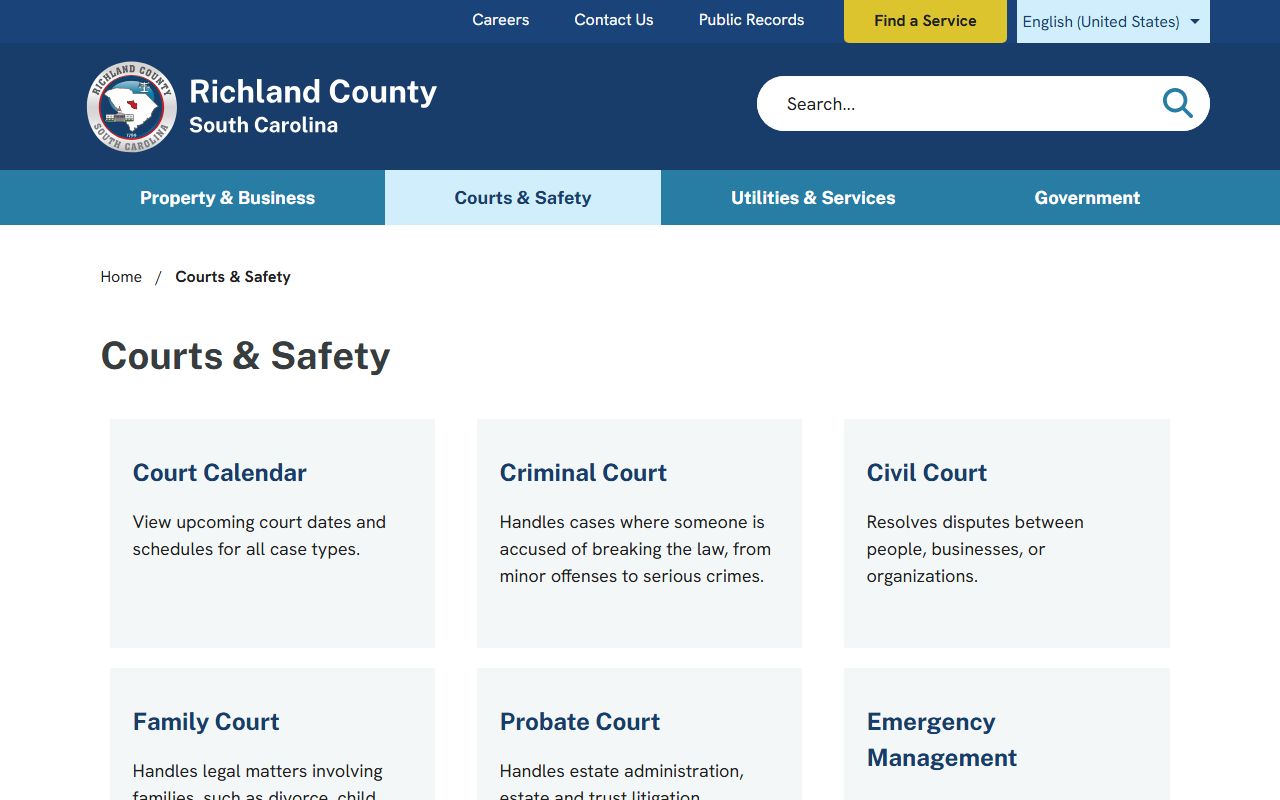
For records the courts do not hold, the county's FOIA channel handles open-records requests; see the Richland County public records page.
Records That Are Restricted or Confidential
Not every court file is open. Juvenile records are confidential under the Juvenile Justice Code. Adoption records are closed under FOIA's own definitions. Mental health and commitment files held by Probate Court stay private. Sealed and expunged records drop out of public view by court order. Public court systems also redact Social Security numbers, financial account numbers, and protected addresses.
To view a sealed record, a person usually needs a court order or a statutory right of access. Many adult expungements run through the Fifth Circuit Solicitor's office under state law. The General Sessions page explains how criminal records and expungement orders are handled by the Clerk. It is shown below.
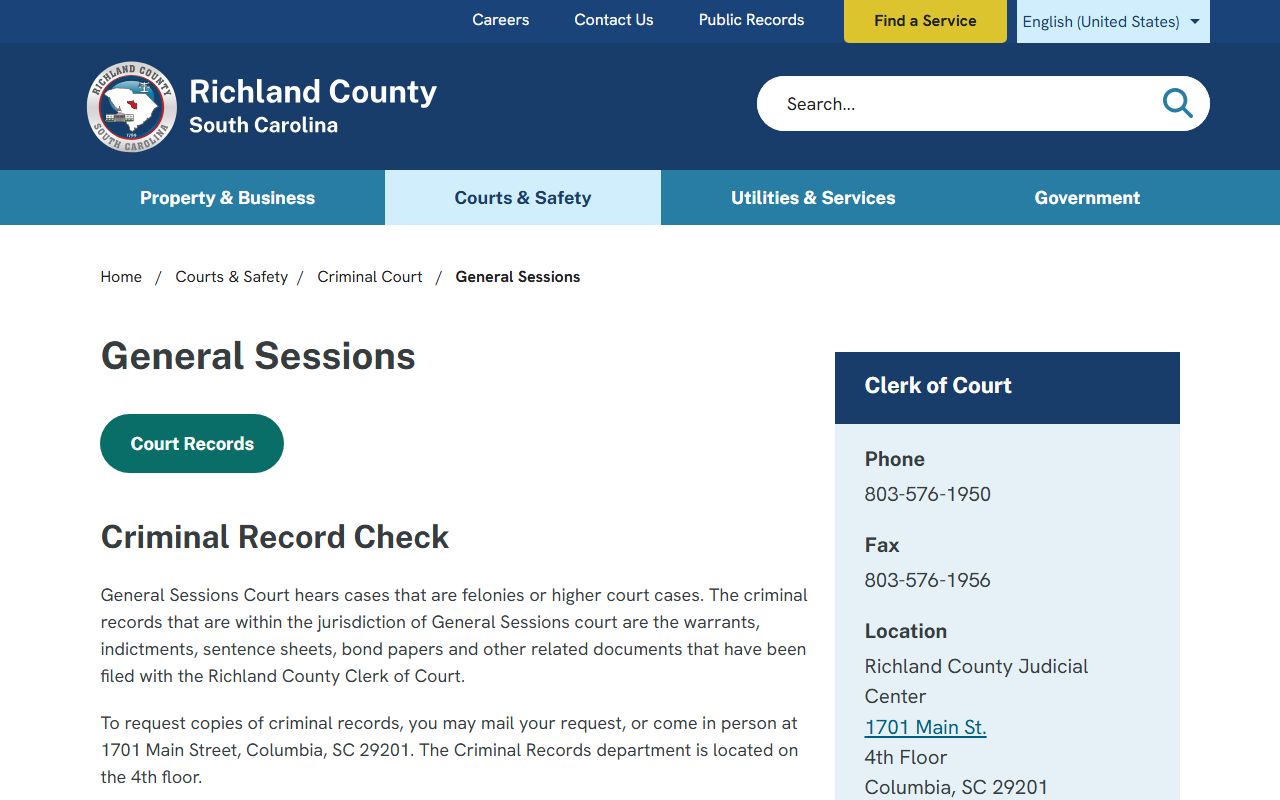
Expungement-order payments to the Clerk must be by postal money order or cashier's check, or the order will not be filed.
Specialty Programs in Richland County
Richland County uses some alternatives to standard prosecution and jail. The Sheriff's Department runs a Law Enforcement Assisted Deflection (LEAD) program, framed as a way to redirect people whose conduct stems from unmet behavioral-health needs instead of repeated jail and court cycles. The county also supports community service or electronic monitoring for low-risk people, which can ease jail crowding.
Family Court offers a protection path for domestic matters; a judge may issue a restraining order, and Sistercare keeps an office in the Family Court building. The Public Defender page names E. Fielding Pringle as Chief County Public Defender for Richland County. That page is shown below.
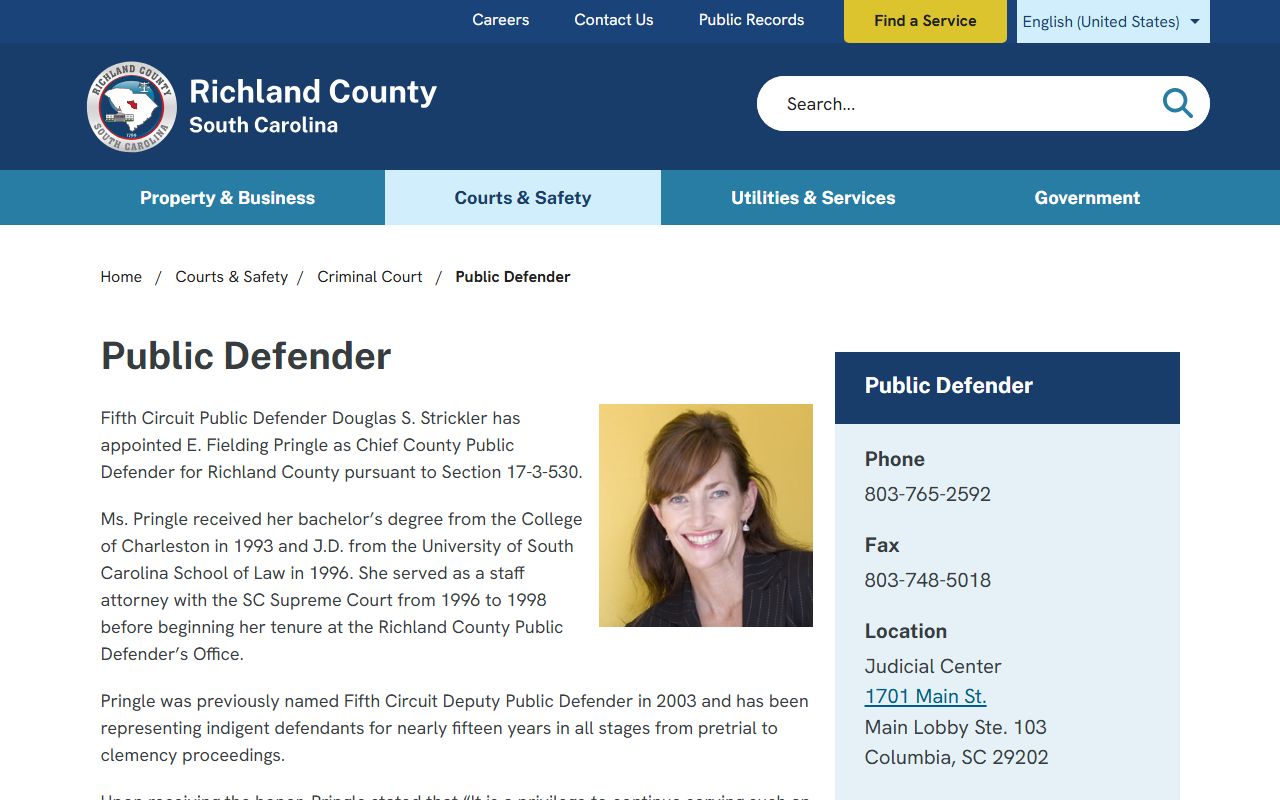
Qualifying defendants can reach the Public Defender at 803-765-2592, with indigent screening at 803-576-1621.
Richland County Sheriff and Jail
The Richland County Sheriff is Leon Lott. The Sheriff's Department is at 5623 Two Notch Road, Columbia, SC 29223, phone 803-576-3000, with an anonymous tip line at 888-CRIME-SC. People arrested in the county are taken to the Alvin S. Glenn Detention Center at 201 John Mark Dial Drive, the intake jail for Richland County. Bond Court at the same address decides who can be released before trial.
The county Criminal Court page describes General Sessions, the Solicitor, the Public Defender, Traffic Court, and Bond Court. It is shown below. See Richland County inmate records for the full jail roster details and warrant records for how warrants are handled.
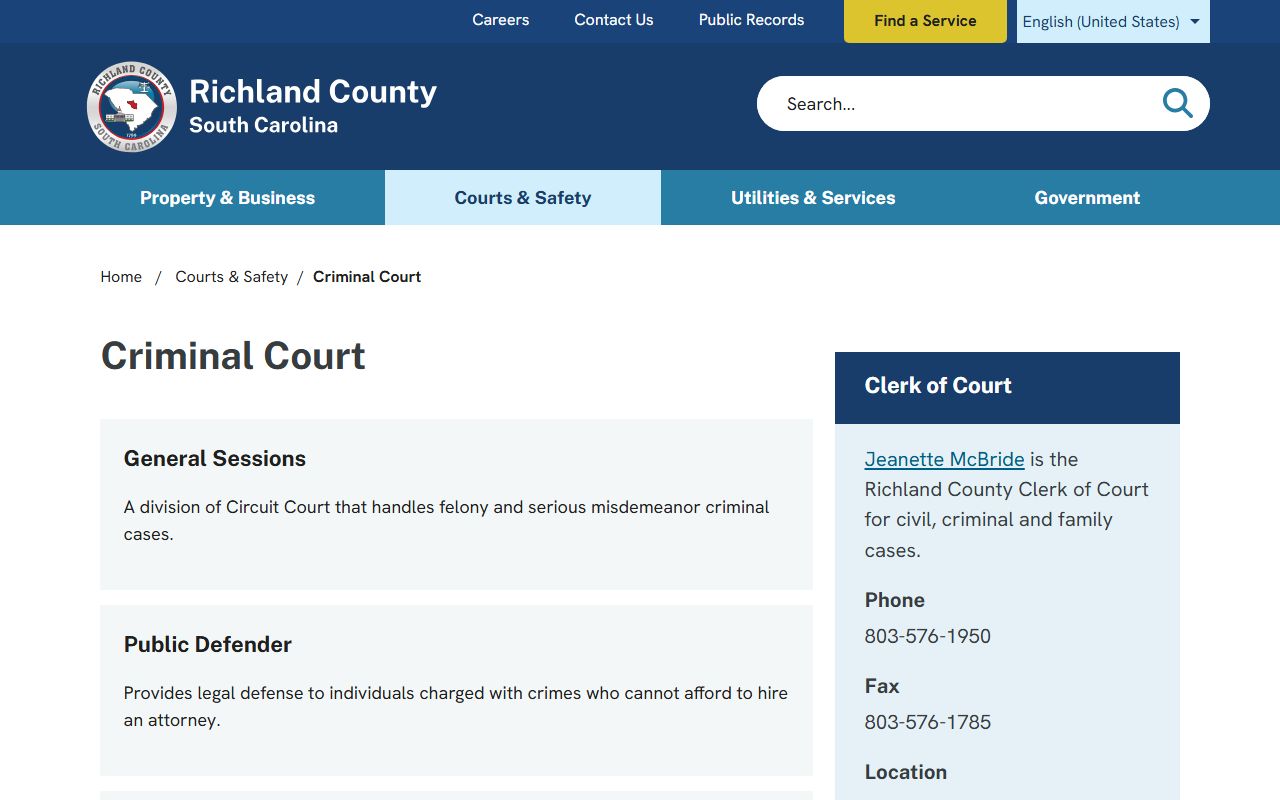
Jail data can update faster than the Public Index right after an arrest, so the detainee lookup is the quickest custody check.
Marriage, Divorce, and Probate Records
Richland County Probate Court issues marriage licenses and sells certified copies, both online only. The license fee is $45.24, with a 24-hour waiting period after the application is received. Divorce is a Family Court matter, with a $150 filing fee to open a case. Estate records run from 1900 to the present at Probate Court. See marriage and divorce records and probate records for the full process and contacts.
- Testator
- A person who makes a will.
- Executor
- The person named to carry out a will, also called a personal representative.
- Conservator
- A person a court appoints to manage another person's property or finances.
The county Family Court page lists the filing fee and notes that the court does not hand out generic divorce forms. It is shown below.
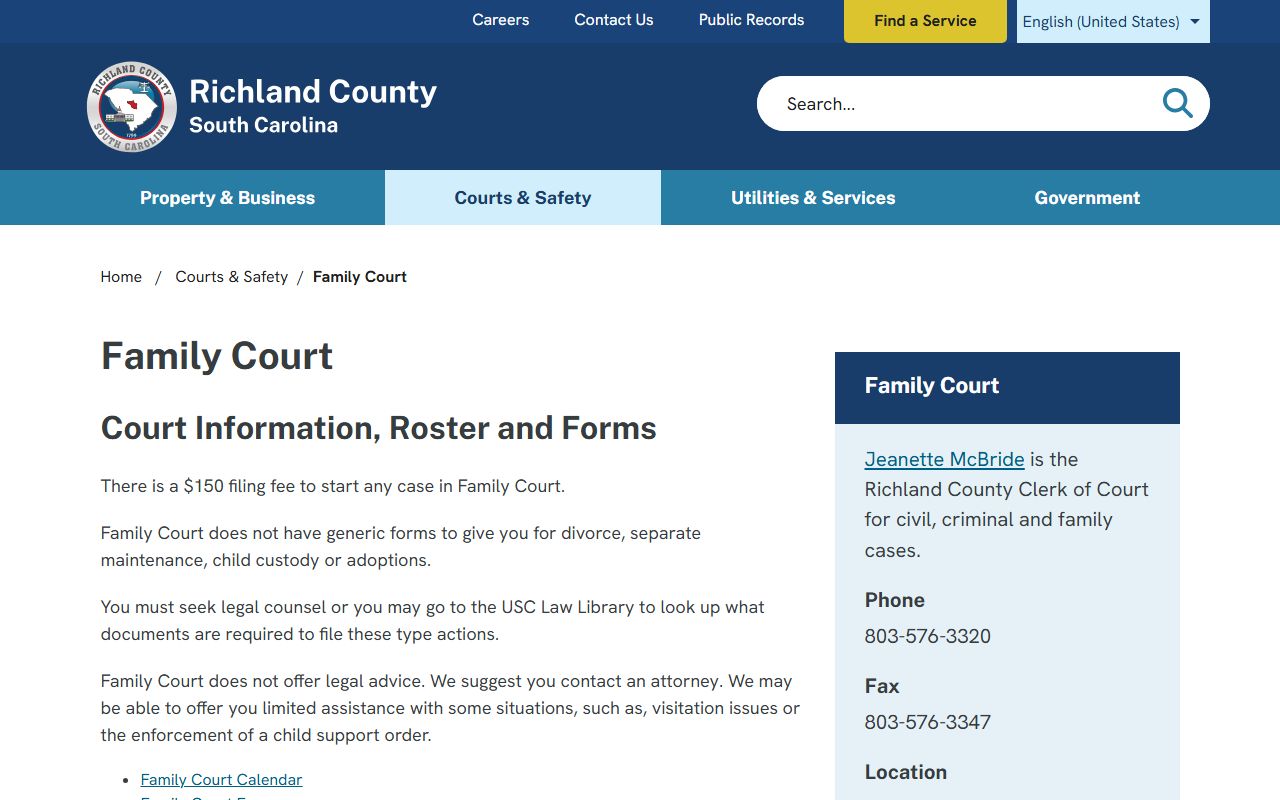
Family Court tells filers to seek legal counsel or use the USC Law Library to prepare the right documents.
Richland County Court Records Fees
Fees depend on the office and the service. Probate sets clear copy fees for estate records. The Master-in-Equity charges set amounts for foreclosure and related filings. Family Court charges a flat fee to open a case. The Clerk's per-page certified copy fee is not published online, so call the Clerk at 803-576-1950 to confirm before you mail payment.
| Item | Amount |
|---|---|
| Family Court case filing fee | $150 |
| Marriage license | $45.24 |
| Marriage certified copy | $8 per copy |
| Probate estate record, in-office copy | $0.50 per copy |
| Probate estate record, mail search fee | $3.00 |
| Master-in-Equity foreclosure / partition | $125 |
How to Interpret Richland County Court Records
Court records use shorthand. The case number tells you the court: CP means Common Pleas, and the 40 marks Richland County. A docket is the running list of every filing and order. A disposition is the final outcome. An arrest or a charge is not a conviction; only a plea or a verdict of guilt is. "Dismissed" means the case ended without a conviction, and "nolle prosequi" means the State dropped the charge.
Watch the difference between a charge and a conviction when you read a criminal file. Pending charges can still be dropped, reduced, or sent to a diversion program. For the cleanest picture, read the full docket and the final order, not just the first entry.
Accuracy and Record Limitations
Online records can lag behind the courthouse. New filings, bond changes, and dispositions may take time to post to the Public Index. The index is also a docket and index system, not a certified record, and it does not include every Magistrate or Municipal case. For a legal-grade copy, you still need the clerk. To fix an error in a file, contact the clerk division that holds it.
Note: Always confirm case details with the clerk or court that holds the file before you rely on an online entry for any legal, financial, or personal decision.
History of Richland County Courts
Richland County is an old South Carolina county, with Columbia serving as both county seat and state capital. The court system today works inside the state's unified judiciary, where Circuit, Family, Probate, Magistrate, Municipal, and Master-in-Equity functions split by subject rather than by separate county courts. Family Court became a uniform statewide system by statute in 1976. Probate Court stays locally elected. Estate records reach back to 1900, with files since 1983 scanned for public computers, which shows how record access has moved online over time.
Frequently Asked Questions
How do I search Richland County court records online?
Use the South Carolina Judicial Branch Public Index for Richland County, or start at the statewide Case Records Search page and select Richland. Turn on cookies and JavaScript, and add a pop-up exception if case detail windows fail to open. Search by case number when you have it, since South Carolina case numbers code the court and county. Otherwise, search by last name, then narrow with a first name, court type, and a filing-date range.
Can the Clerk run a full criminal background check?
No. The Clerk's records do not include Magistrate or Summary Court cases, and the office does not perform a certified records check. For a full statewide criminal history, contact SLED at 803-737-9000 or use SLED CATCH at catch.sled.sc.gov. The Clerk can still give you copies of General Sessions criminal files held on the 4th floor of the Judicial Center.
Where do I get a Richland County marriage license?
Richland County Probate Court issues marriage licenses. Applications are online only, paid by debit or credit card, with a fee of $45.24. South Carolina requires a 24-hour waiting period after the application is received, then Probate mails the license. No blood test is needed, and residency is not required to use a South Carolina license for a South Carolina marriage.
More on the Richland County Court Records FAQ page.